New version
frostlake
frostlake 0.2.0
Version added to the index
Alire community mirror
A daily shadow of the Alire community catalog, rendered with the same package, version, relationship, and JSON views as the Flyology index.
alr index --reset-community825 packages
2306 manifests
708 source crates
v1.4.0 index format
Index activity
Crates and versions recently added or updated in this index.
0.2.00.1.00.3.01.6.00.2.01.5.020 open crate PRs in the community index. Inspect pending changes
Package list
Search by name, description, version, or tag. Each package includes its dependencies, origin, availability rules, and complete parsed manifest.
Showing all 825 packages
The a0b_base crate provides the root package hierarchy and foundational components tailored for embedded, bare-metal, and low-level Ada applications.
Key features include:
Integer_* and Unsigned_* types of various sizes (1 to 64 bits) with shift and rotate operations.Unsigned_*_Array types and "Enumerable" modular types (2 to 8 bits).A0B.Types.Big_Endian) for low-level protocol specifications.bswap, clz, ffs) in A0B.Types.GCC_Builtins.Provides memory-safe data buffer abstractions with customizable allocation strategies (fixed and dynamic capacity), optimized for I/O handling and serialization builders.
The a0b-sensirion crate provides essential low-level utilities for interfacing with Sensirion sensors, specifically focusing on the data integrity requirements of their communication protocols. It offers specialized routines for CRC calculation and provides automated packet encoding and decoding logic that handles the insertion and deletion of CRC bytes. By abstracting these boilerplate tasks, the crate ensures reliable data transmission and simplifies the implementation of drivers for any Sensirion hardware utilizing checksum-protected packets.
The primary tool in this crate is the a0b-runtime generator.
While GNAT provides several standard runtimes (such as light, light-tasking, and embedded), these can be difficult to customize for specific project requirements.
a0b-tools solves this by allowing developers to generate a tailored, project-specific runtime from a single configuration file.
It also enables the creation of runtimes for hardware platforms and MCUs that do not have prebuilt GNAT runtimes available, providing full control over startup code, linker scripts, and Ada library components.
Alex's Ada Assortment of Utilities
An Ada-oriented GUI
Traditionally, GUIs have been implemented by the client registering callback operations, then giving up its thread of control to the GUI. This is a hack to address the inherent parallelism of a GUI in sequential languages. It results in code that is unnecessarily difficult to understand.
In a concurrent language like Ada, a better design for a GUI is for the GUI to have its own task, so it doesn't require that its client give up a thread of control. GUI events are communicated to the client through a protected queue of events. The client software can be written in the clearest way possible, unconstrained by the GUI.
Ada_GUI is such a GUI.
The purpose of Ada_GUI is to provide the specification, in hopes that multiple implementations will be created. Note that some of the comments in the specification are specific to the sample implementation, and should be removed or modified for other implementations. Especially interesting would be an implementation that is not GNAT specific.
A sample implementation of Ada_GUI is supplied, derived from Gnoga, but simplified, reorganized, and converted to put events on a protected queue rather than call callbacks. The name Gnoga has been retained for the name of the implementation hierarchy, located at Ada_GUI.Gnoga, in recognition. Those parts of Kazakov's Simple Components used by the implementation are provided as well, with some minor modifications. If you have your own version of the Simple Components, you may use it instead: Delete all Ada source files that do not begin with ada_gui.
The sample implementation is reasonably full-featured and useful. The implementation is more responsive than the former proof-of-concept directly on full Gnoga.
The Test directory contains boot.html, boot.js, and jquery.min.js. These files must be available to every Ada-GUI program. It also contains favicon.ico, an icon of Ada.
Show_All creates at least one of each widget. Visibility, playing audio, and responding to key-press events is demonstrated. Changing this program is the easiest way to experiment with the sample implementation. The audio file glass.ogg and image file rgb.jpg are used by Show_All.
Luhn_Gen calculates Luhn checksum digits. Enter the first 15 digits of your credit-card number and it will generate the 16th.
Random_Int is a Gnoga program that has been revised to use Ada GUI instead. It will generate random integers in a desired range.
Gnoga and the Simple Components require a recent GNAT compiler, so Ada_GUI cannot be compiled with another compiler. The file gnat.adc is needed to compile the Simple Components extensions to GNAT.Sockets. The use of gnatmake is recommended, as gprbuild is for mixed-language or complicated builds, which this is not. After compiling, it is recommended that you write-protect the .ali files. Typically, you can use a command such as
gnatmake -m -j0 -gnat12 -gnatan -gnato2 -O2 -fstack-check Test/show_all.adb
If you keep the Ada-GUI source files in a single directory, including the Simple Components source files, and have the compiler put the object and .ali files in that directory, then you need only add -I/path/to/Ada_GUI/ to your program's gnatmake command to use Ada_GUI.
ada-toml is a pure Ada library for parsing and creating
TOML documents. It conforms to the
version 1.0.0 of the format standard.
All basic types and subprograms are in the TOML package. All "nodes" in a
TOML documents are materialized using the TOML.TOML_Value type. Since TOML
values make up a tree, this type has reference semantics. This means that
modifying a TOML node does not modify the corresponding TOML_Value value
itself, but rather the TOML value that is referenced.
Parsing a TOML file is as easy as using the TOML.File_IO.Load_File function:
declare
   Result : constant TOML.Read_Result :=
      TOML.File_IO.Load_File ("config.toml");
begin
   if Result.Success then
      Ada.Text_IO.Put_Line ("config.toml loaded with success!");
   else
      Ada.Text_IO.Put_Line ("error while loading config.toml:");
      Ada.Text_IO.Put_Line
         (Ada.Strings.Unbounded.To_String (Result.Message));
   end if;
end;
Each TOML value has kind, defining which data it contains (a boolean, an integer, a string, a table, ...). To each kind, one or several primitives are associated to let one process the underlying data:
case Result.Kind is
   when TOML.TOML_Boolean =>
      Ada.Text_IO.Put_Line ("Boolean: " & Result.As_Boolean'Image);

   when TOML.TOML_Integer =>
      Ada.Text_IO.Put_Line ("Boolean: " & Result.As_Integer'Image);

   when TOML.TOML_String =>
      Ada.Text_IO.Put_Line ("Boolean: " & Result.As_String);

   when TOML.TOML_Array =>
      Ada.Text_IO.Put_Line ("Array of " & Result.Length & " elements");

   when others =>
      null;
end case;
There are also primitives to build TOML values:
declare
   Bool : constant TOML.TOML_Value := TOML.Create_Boolean (False);
   Int  : constant TOML.TOML_Value := TOML.Create_Integer (10);
   Str  : constant TOML.TOML_Value := TOML.Create_String ("Hello, world");

   Table : constant TOML.TOML_Value := TOML.Create_Table;
begin
   Table.Set ("bool_field", Bool);
   Table.Set ("int_field", Int);
   Table.Set ("str_field", Str);
end;
And finally one can turn a tree of TOML nodes back in text form:
Ada.Text_IO.Put_Line ("TOML document:");
Ada.Text_IO.Put_Line (Table.Dump_As_String);
The development of ada-toml happens on
GitHub. Everyone is welcome to
contribute to this project: please read our contribution
rules if
you consider doing so.
Ada Class Library core crate for Ada 2022.
adacl is the shared root of the AdaCL family. It is suitable for both
embedded and desktop targets and is proven to SPARK gold. The former
desktop utilities no longer live here; they were moved to adacl_desktop
in 8.0.0.
Sister crates:
Source: SourceForge Documentation: GNATdoc
A versatile Ada 2022 testing library, enhancing AUnit with readable assertions and parameterised tests.
Example for unbounded strings:
    procedure Equal
       (Actual	 : Ada.Strings.Unbounded.Unbounded_String;
	Expected : String;
	Name	 : String;
	Source	 : String  := GNAT.Source_Info.File;
	Line	 : Natural := GNAT.Source_Info.Line)
    is
       use Ada.Strings.Unbounded;
    begin
       if not (Actual = Expected) then
	  Report_Assertion
	     (Message => "In string «" & Name & "» the " & Actual'Image & " is not equal to " & Expected'Image,
	      Source  => Source,
	      Line    => Line);
       end if;
    end Equal;
This yields clear, context-rich error messages, surpassing standard AUnit output.
Run the same test with varied inputs and expected values, boosting coverage efficiently.
Example from hp41cx_tools:
overriding procedure Register_Tests (T : in out Test_Case) is
   pragma Debug (AdaCL.Trace.Entering (In_Parameter => T.Name.all'Image));
begin
   T.Parameter.Register_Routine (T, Test_To_HP_Duration_01'Access, "WAKE_UP",	   "2024-12-01 08:00:00",   [3, 9, 4, 2, 0, 2, 8, 8, 0, 0, 0], 3942028800.0);
   T.Parameter.Register_Routine (T, Test_To_HP_Duration_01'Access, "^LBLTEST",	   "2025-07-22 12:00:00",   [3, 9, 6, 2, 1, 7, 4, 4, 0, 0, 0], 3962174400.0);
   T.Parameter.Register_Routine (T, Test_To_HP_Duration_01'Access, "TONE",	   "2025-11-12 09:12:34",   [3, 9, 7, 1, 9, 2, 7, 5, 5, 4, 0], 3971927554.0);
   T.Parameter.Register_Routine (T, Test_To_HP_Duration_01'Access, "FRACTION",	   "2025-11-12 09:12:34.5", [3, 9, 7, 1, 9, 2, 7, 5, 5, 4, 5], 3971927554.5);
   T.Parameter.Register_Routine (T, Test_To_HP_Duration_01'Access, "REPEAT24",	   "24:00:00",		    [0, 0, 0, 0, 0, 8, 6, 4, 0, 0, 0], 0000086400.0);
   T.Parameter.Register_Routine (T, Test_To_HP_Duration_01'Access, "REPEAT'First", "0000:00:01.0",	    [0, 0, 0, 0, 0, 0, 0, 0, 1, 0, 0], 0000000010.0);
   T.Parameter.Register_Routine (T, Test_To_HP_Duration_01'Access, "REPEAT'Last",  "9999:59:59.9",	    [0, 0, 3, 5, 9, 9, 9, 9, 9, 9, 9], 0035999999.9);
   pragma Debug (AdaCL.Trace.Exiting);
   return;
end Register_Tests;
Registering tests multiple times with different data enhances test coverage without redundant code.
Source: SourceForge Documentation: GNATdoc
Ada Class Library desktop crate for Ada 2022.
This crate holds the former adacl desktop API. Use it for hosted
applications that need command-line handling, wide-character text,
diagnostics, queues, or smart pointers. It depends on the SPARK-proven
adacl core.
Features:
Source: SourceForge Documentation: GNATdoc
Encoding-aware string utilities for Ada 2022, developed by Björn Persson for robust internationalization (i18n).
Supports text processing with the following encodings:
Additional features:
Licensed under GPL-3.0-or-later. Integrates with the Ada Class Library (AdaCL).
Source: SourceForge Documentation: GNATdoc
AdaCL Embedded - Lightweight Embedded Ada Library
AdaCL-Embedded focuses on embedded and real-time programming on the Raspberry Pi and similar platforms.
It favours predictability, minimal runtime overhead, and static data structures. Object-oriented programming, unbounded strings, and wide strings are avoided or kept to an absolute minimum.
Variant
no_tasking - for the lightest runtimes (no protected objects). Also works well with interrupt-driven runtimes.tasking - for runtimes with tasking support.Event_Log_Buffer_Length - maximum length of each trace line (default: 200, min: 1, max: 1024)Event_Log_Buffer_Size - number of entries in the ring buffer (default: 0, max: 1024, min: 0 (buffer disabled))A text length of 200 is the standart minimum used in the Ada Standart (i.E. Ada.Text_IO.Get_Line, exception messages,
etc.pp).
Memory needed is approximately (Event_Log_Buffer_Length + 4) * Event_Log_Buffer_Size bytes, plus some overhead for the
buffer management. For example: 1024 buffer size with 200 line lenght is about the maximum size that can be used with
the static memory of Raspberry Pi Pico. The buffer size can be set to 0 to disable the trace buffer and the related code
completely.
Source: SourceForge Documentation: GNATdoc
Regular expression and SPITBOL pattern matching for Ada 2022, with wide character support.
Features:
Licensed under GPL-3.0-or-later. Integrates with the Ada Class Library (AdaCL).
Source: SourceForge Documentation: GNATdoc
Powerful search-and-replace library for Ada 2022, developed by Martin Krischik, with wide and wide-wide character support.
Features:
Licensed under GPL-3.0-or-later. Integrates with the Ada Class Library (AdaCL).
Source: SourceForge Documentation: GNATdoc
Thin, SPARK-friendly helpers for character and string I/O on a GNAT.Serial_Communications port.
The package is deliberately compact - it contains only AdaCL.Serial_IO.
It extends GNAT.Serial_Communications.Serial_Port (itself a descendant of Ada.Streams.Root_Stream_Type) with a null-record derivation, turning the type into a true class. Consequently all operations can be written with the convenient Class.Method syntax (Port.Get, Port.Put_Line, Port.Expect, ...).
Provided facilities:
Intended for console-style protocols used by classic and modern retro calculators (SwissMicros DM-series, HP-IL emulators, etc.).
Licensed under the GNU Library General Public License version 3 (or later). Integrates with the Ada Class Library (AdaCL).
Dilithium is a digital signature scheme that is strongly secure under chosen message attacks based on the hardness of lattice problems over module lattices. The security notion means that an adversary having access to a signing oracle cannot produce a signature of a message whose signature he hasn't yet seen, nor produce a different signature of a message that he already saw signed. Dilithium is one of the candidate algorithms submitted to the NIST post-quantum cryptography project.
  Adare_Dilithium5 is a Ada 2012 bind to Dilithium5 C.

  (C version at https://github.com/PQClean/PQClean)

  How a Bonus all Ada packages in this lib is "Ada Pure"! :-)
HQC (Hamming Quasi-Cyclic) is a code-based public key encryption scheme designed to provide security against attacks by both classical and quantum computers. HQC has been submitted to the NIST's Post-Quantum Cryptography Standardization Project.
  Adare_HQC256 is a Ada 2012 bind to HQC-256 C.

  Adare_HQC256 has a 512 bits Shared Secret size.

  (C version at https://github.com/PQClean/PQClean)

  How a Bonus all Ada packages in this lib is "Ada Pure"! :-)
Main features:
Middleware layer of the Ada Drivers Library project.
This crate is a snapshot of the middleware of Ada Drivers
Library.
Any bug report, issue, contribution must be adressed to the Ada Drivers Library repo.



Ada Database Objects is an Ada05 library that provides object relational mapping to access a database in Ada05. The library supports Postgresql, MySQL, SQLite as databases. Most of the concepts developped for ADO come from the Java Hibernate ORM.
The ORM uses an YAML, XML mapping file or an UML model, a code generator and a runtime library for the implementation. It provides a database driver for Postgresql, MySQL, SQLite or SQLCipher. The ORM helps your application by providing a mapping of your database tables directly in the target programming language: Ada05 in our case. The development process is the following:
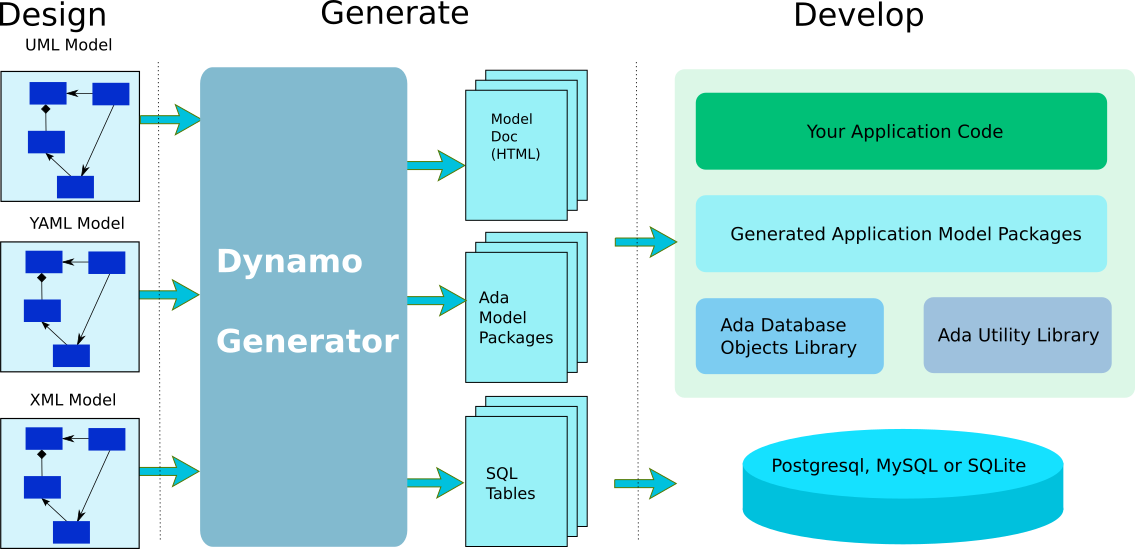
You need at least one of these databases (or all of then). The configure script will now fail if no supported database was found. Check the Database Drivers section to install them and run the configure again after the installation.
This crate give access to the PostgreSQL, MySQL and SQLite drivers for the Ada Database Objects library.
This is the MySQL driver for the Ada Database Objects library.
This is the PostgreSQL driver for the Ada Database Objects library.
This is the SQLite or SQLCipher driver for the Ada Database Objects library.
The choice between SQLite and SQLCipher is controlled by the ADO_USE_SQLCIPHER gpr external variable.
Use -XADO_USE_SQLCIPHER=yes if you want to use the SQLCipher support. The database encryption key
is configured by using a pragma key.
aDSA is a Partition Communication Subsystem (PCS) for Ada's Distributed
Systems Annex (Annex E), replacing the discontinued PolyORB/GLADE runtime.
alr build produces two ordinary tools:
pcs_gnatdist -- the gnatdist replacement: builds a distributed
application from its .cfg, auto-assembling the GARLIC runtime (a
--RTS overlay of the toolchain's own runtime) on first use and
re-assembling it when the toolchain changes;pcs_supervisor -- launches and restarts a built deployment per its
.manifest.System prerequisites beyond the toolchain: libzmq >= 4.x and zlib
(pacman -S zeromq, apt install libzmq3-dev, pkg install libzmq4;
Windows setup is in the README's Platforms section).
Start with docs/users-guide.md; examples/ holds runnable demos.
Aflex is a lexical analyzer generating tool similar to the Unix tool lex.
The first implementation was written by John Self of the Arcadia project at the University of California, Irvine. The last version that was released appeared to be the aflex 1.4a released in 1994.
Aflex was used and improved by P2Ada, the Pascal to Ada translator. This version of Aflex is derived from the P2Ada aflex implementation released in August 2010.
This version brings a number of improvements:
%unit directive.%option reentrant,
%yyvar and %yydecl directives.This crate provides a library for designing high-quality industrial control widgets for Ada applications. The software is based on GtkAda, Ada bindings to Gtk+, and cairo.
The key features of the library are:
For further information, visit the AICWL website.
Maintainer's note:
This Alire crate is packaged in a rather minimalistic way to keep dependencies on external libraries at a minimum. The crate's definition covers the core functionality of AICWL, though, so it should be sufficient for most needs.
For example, the original distribution has references to Simple Components which are not strictly necessary for the core functionality of the library.
Aion is a structured asynchronous runtime for Ada, built for reliable networking, deterministic concurrency, cancellation-safe tasks, futures, timers, channels, supervision, observability, and production-grade systems software.


AKT is a tool to store and protect your sensitive information and documents by encrypting them in secure keystore (AES-256, HMAC-256).
Create the keystore and protect it with a gpg public key:
akt create secure.akt --gpg <keyid> ...
Store a small content:
akt set secure.akt bank.password 012345
Store files, directory or a tar file:
   akt store secure.akt notes.txt
   akt store secure.akt contract.doc
   akt store secure.akt directory
   tar czf - . | akt store secure.akt -- backup
Edit a content with your $EDITOR:
   akt edit secure.akt bank.password
   akt edit secure.akt notes.txt
Get a content:
   akt get secure.akt bank.password
   akt extract secure.akt contract.doc
   akt extract secure.akt -- backup | tar xzf -
ALI_Parse is a parser for the .ali files generated by the GNAT Ada compiler. ALI means Ada Library Information. You find the .ali files in the same directories as the object files (.o) containing the machine code produced by GNAT.
Currently, ALI_Parse is focused at cross-references within a set of Ada source files. Two command-line tools using the parser are provided:
ALI_Parse is pure Ada 2012 and doesn't depend on any other resource.
There are two prerequisites for your project to work with this tool:
executables field. Its first value
has to be the main application program. Otherwise, the executable program
can be specified on the command line.alr2appimage will use the following command for installing it (this requires Alire 2.0):
alr install
Or it will run gprinstall inside alr exec, if the former fails (Alire 1.x).
If you simply run the tool inside an Alire crate, it will read the
metadata from your alire.toml file and create a default AppImage
from it.
NOTE: alr2appimage is an independent project; it is not
affiliated to, nor supported by, the Alire or AppImage projects.
PDF_Out is an Ada package for producing easily and automatically PDF files, from an Ada program, with text, vector graphics and raster graphics.
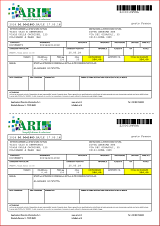
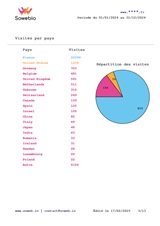
The creation of a PDF file is as simple as this small procedure:
with PDF_Out;

procedure Small_Demo is
  pdf : PDF_Out.PDF_Out_File;
begin
  pdf.Create ("small.pdf");
  pdf.Put_Line ("This is a very small demo for PDF_Out...");
  pdf.Close;
end Small_Demo;


The resource embedder allows to embed files in binaries by producing C, Ada or Go source files that contain the original files.
To generate a config.ads and config.adb Ada package with the resources, you may use:
are --lang=Ada -o src --resource=config --name-access --fileset='**/*.conf' config
Complex resource integrations are best described with and XML and are generated with:
are --lang=Ada -o src --rule=package.xml --name-access .
For Ada, it generates the following package declaration with the Get_Content function
that gives access to the files. The Ada body contains the content of each embedded file.
package Config is
  function Get_Content (Name : in String)
    return access constant String;
end Config;
/badge.svg)


ASFML is an Ada semi-thick binding to the SFML library. It uses Ada types and portable defined types which eliminates the inclusion of Ada interface libraries, but most of the functions are directly imported.
Generated API documentation can be consulted online.
The Ada API follows the CSFML interface, but with some changes and additions for ease of use.
Applicability of the SFML documentation is usually straightforward.
Useful for writing shell-like applications or applications which start, stop and interact with spawned OS programs.
Atari ATR Tools is a versatile, cross-platform utility written in Ada 2022 for managing ATR disk image files used by Atari 8-bit emulators (e.g., Altirra, Atari800) and hardware add-ons like SIO2PC. Unlike most existing tools, which are Windows-only, this tool runs seamlessly on macOS, Linux, and Windows, making it ideal for retro computing enthusiasts across all major platforms.
Key features include:
Header Analysis: Display detailed metadata of ATR files, including sector size, disk density, track count, and boot sector presence.
  > atr_tools-main --print-header test-DD-DS-80.atr
  File name	   : test-DD-DS-80.atr
  Magic		   :	  16#296#
  Paragraphs	   :	    46056
  Sector size	   :	      256
  Flags		   :	     2#1#
  Bad Sectors	   :		0
  Unused	   :	    16#0#
  Sectors	   :	     2880
  Bytes		   :	   736896
  Boot Sectors	   : true
  Floppy disk double density, double sided, 80 track
Floppy Image Creation: Format and create ATR files for various disk configurations (e.g., single-sided, double-density, 80 tracks).
> atr_tools-main --verbose --format-floppy --density=DD --side=SS --track=80 test-DD-SS-80.atr
File created	 : test-DD-SS-80.atr
Sector size	 :	    256
Sector per track :	     18
Tracks per side  :	     80
Sides per disk	 :	      1
The tool includes a comprehensive test suite to ensure reliability across platforms and configurations. Source code and tests are available on SourceForge. Detailed GNATdoc documentation can be found at 6502 Tutorial.
Atari EXE Tools is a robust, cross-platform utility written in Ada 2022 for analysing Atari 8-bit executable (EXE) files, used in Atari 400/800 and XL/XE systems or emulators like Altirra and Atari800. Unlike most existing tools, which are typically Windows-only, this tool operates seamlessly on macOS, Linux, and Windows, making it an essential asset for retro computing enthusiasts and developers working across diverse platforms.
Key features include:
Header Analysis: Extract and display detailed metadata from EXE files, including memory start/end addresses, segment lengths, and init/run vectors.
  > exe_tools-main --print-header ./test/share/atari_check_exe_test/HELLO_C.EXE
  File: ./test/share/atari_check_exe_test/HELLO_C.EXE
  Magic: $FFFF; Start: $2E00; End: $2EF5; Length: 246
  Magic: $0000; Start: $02E2; End: $02E3; Length: 2; Init: $2E47
  Magic: $0000; Start: $2400; End: $28DE; Length: 1247
  Magic: $0000; Start: $02E0; End: $02E1; Length: 2; Run: $2401
Data Dumping: Output hexadecimal data from EXE files for inspection, with ATASCII portions omitted to ensure compatibility with non-UTF-8 environments.
> exe_tools-main --print-data ./test/share/atari_check_exe_test/HELLO_A.EXE
File: ./test/share/atari_check_exe_test/HELLO_A.EXE
2400: 60 60 A2 00 A9 0B 9D 42 03 A9 3F 9D 44 03 A9 24
2410: 9D 45 03 A9 2E 9D 48 03 A9 00 9D 49 03 20 56 E4
2420: A2 00 A9 07 9D 42 03 A9 6D 9D 44 03 A9 24 9D 45
2430: 03 A9 01 9D 48 03 A9 00 9D 49 03 20 56 E4 60 48
2440: 65 6C 6C 6F 20 57 6F 72 6C 64 21 9B 28 75 73 69
2450: 6E 67 20 61 20 65 78 65 63 75 74 61 62 6C 65 20
2460: 69 6E 20 61 73 73 65 6D 62 6C 65 72 29 9B 00
02E0: 02 24
Run: $2402
The tool includes a comprehensive AUnit test suite to ensure reliability across platforms and Atari 8-bit configurations. Source code and tests are available on SourceForge. Detailed GNATdoc documentation can be found at 6502 Tutorial.
This crate contains basic Ada packages for audio applications.
This crate contains Ada packages for wavefile I/O.



Ada Web Application is a framework to build a Web Application in Ada 2012. The framework provides several ready to use and extendable modules that are common to many web application. This includes the login, authentication, users, permissions, managing comments, tags, votes, documents, images. It provides a complete blog, question and answers and a wiki module.
AWA simplifies the Web Application development by taking care of user management with Google+, Facebook authentication and by providing the foundations on top of which you can construct your own application. AWA provides a powerful permission management that gives flexibility to applications to grant access and protect your user's resources.
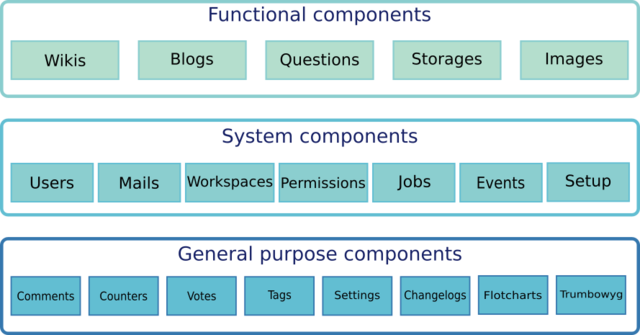
The Ada Web Application programmer's guide describes how to setup the framework, how you can setup and design your first web application with it, and it provides detailed description of AWA components:
Ada Web Application is a framework to build a Web Application in Ada 2012. The framework provides several ready to use and extendable modules that are common to many web application. This includes the login, authentication, users, permissions, managing comments, tags, votes, documents, images. It provides a complete blog, question and answers and a wiki module.
This library provides a testing framework on top of AWA top help implementing unit tests for AWA applications.
The Ada Web Application programmer's guide describes how to setup the framework, how you can setup and design your first web application with it, and it provides detailed description of AWA components:
Ayacc is an Ada parser generator in the style of yacc(1).
The first implementation was written by David Taback and Deepak Tolani at the University of California, Irvine. The last version that was released appeared to be the Ayacc 1.1 released in 1994.
Ayacc was used and improved by P2Ada, the Pascal to Ada translator. This version of Ayacc is derived from the P2Ada ayacc implementation released in August 2010.
This version brings a number of improvements:
AZip is a free Zip Archive Manager with unique features such as: built-in content Search, smart archive Update, archive Recompression.
Features:
Some features:
The creation of a bar code is as simple as this small procedure:
with Ada.Text_IO, Bar_Codes, Bar_Codes_Media;

procedure Small_Demo is
  use Ada.Text_IO;
  svg : File_Type;
begin
  Create (svg, Out_File, "qr_code.svg");
  Put_Line
    (svg,
     Bar_Codes_Media.SVG_Bar_Code
       (Bar_Codes.Code_QR_Low, (5.0, 5.0, 100.0, 100.0), "mm", "Hello"));
  Close (svg);
end Small_Demo;
First edit you alire.toml file and add the following elements:
bare_runtime in the dependency list:[[depends-on]]
bare_runtime = "*"
[[depends-on]]
gnat_arm_elf = "*"
[gpr-set-externals]
BARE_RUNTIME_SWITCHES = "-mlittle-endian -mthumb -mfloat-abi=hard -mcpu=cortex-m4 -mfpu=fpv4-sp-d16"
Then edit your project file to add the following elements:
with "bare_runtime.gpr";
Target and Runtime attributes: for Target use "arm-eabi";
for Runtime ("Ada") use Bare_Runtime'Runtime ("Ada");
An Ada/SPARK proved implementation of James Munns' BBQueue (https://github.com/jamesmunns/bbqueue)
Constants, functions, and procedures for generating ANSI escape sequences. If you need something that provides more than this, you should take a look at one of the curses/ncurses variants. Refer to the documentation for more information.
This crate contains base classes for some hardware devices such as Analog Inputs, GPIO pins, I2C bus, and SPI bus. It also contains drivers for devices that use, for example, an I2C bus.
By itself, this crate isn't much use. It will need to be used with the bbs_embed_linux crate which contains hardware drivers for the Raspberry Pi and BeagleBone Black.
This contains device drivers for unix-type systems. The physical devices are defined for the Raspberry Pi and BeagleBone Black, but it should compile on any unix-type environment.
This is the core of a simple tiny lisp that is intended to be embedded in other applications. It can be extended with new commands specific to the application.
This contains simulators for the 6502, 8080/8085/Z80, 680000/68008, and some of the PDP-11 (11/04, 11/05,10, 11/15,20, and 11/34) processors.
For the 8080 family, I/O and a BIOS are provided so that CP/M can be run. The standard 8 inch floppy disk images are supported and are useful for accessing a wealth of archived software.
For the PDP-11 processors, some of the DEC I/O is also simulated well enough to be able to run the RT-11 operating system.
More will probably be added with time.


The Ada-BFD is a library which provides Ada API for GNU Binutils BFD library. It works on any version of GNU Binutils (starting at 2.15). The recommended version for GNU Binutils is at least the 2.42.
The Ada-BFD library allows to:
Implementation of a constant time big integer library, inspired by crypto-bigint.
All functions are implemented in constant time, except those with an explicit _Vartime suffix. Overloaded operators are also constant time.
⚠️ The constant time choice primitives like
Ct_Eq,Ct_Gt,Cond_SelectandCSwaprely on best-effort optimisation barriers.
The implementations are generic over the size of the integer:
package U256 is new Bigints.Uint (256);
package U1024 is new Bigints.Uint (1024);
There is also a generic package to deal with modular integers (over a prime field):
P : U256.Uint := ... -- a big prime, like 2**255 - 19
package GF_P is new Bigints.Modular (U256, P);
It is up to the user of the library to ensure the chosen modulus is effectively prime. Otherwise, operations like field inversion become invalid (as it relies on Fermat's little theorem).
The preinstantations in the library (packages U256s and F25519), as well as the constant time primitives and basic limb primitives, are formally checked using GNATprove.
Ordered binary trees implemented without access types
Demonstration of a technique to be presented at the Ada Developers Workshop of the 2024 Ada-Europe conference
SPARK-proved BLAKE3 hash function for Ada 2022. Implements the C2SP BLAKE3 specification with hash, keyed_hash, and derive_key modes. Compression function, G function, byte conversions, chunk processing, and CV-stack Merkle assembly are formally verified at SPARK level 2: 482/482 proof obligations discharged, zero unproved VCs, zero pragma Assume. The BLAKE3 algorithm-level invariant relating CV-stack depth to the chunk counter (popcount bound) is a machine-checked theorem, and the 2**64-byte input cap is an enforced precondition (see SECURITY.md).
No heap allocation, pragma Pure, suitable for embedded and safety-critical systems. Extensible output, incremental API (Init/Update/Final), comprehensive official C2SP test vectors.
Constant-time execution is out of scope for this release. See SECURITY.md for the full threat model.
This is a complex project involving 3D printing and soldering as well as software. Alr will take care of the software dependencies for you, but you will have to read the README and documentation to find the other parts.
This project is intended to replicate the look and feel of older computers with the switches and lights. It uses the simulators from bbs_simcpu to drive the LEDs and act on the switches. Using the Intel 8080 simulator, I was actually able to toggle a bootstrap program in using the panel and get it to boot CP/M. A boot loader (boot.ihx) is included. CP/M is not included. There are places on the web where you can find a disassembled CP/M 2.2. Then combine it with the BIOS from bbs_simcpu and add it to a disk image using the loadcpm tool. If you use the Motorola 68000 simulator, it will load and run a simple multitasking OS. The example simulator can be used to flash the lights in a variaty of ways.
There is a lamp test program in the lamp-test directory that may be useful for debugging the hardware.
Note that since each cycle of the simulator involves multiple I2C bus transactions to read switches and set LEDs, any CPU simulation will run rather slowly. The intention of this project is more for display than simulator usage.
There is also a web server that can be used to select the CPU variant. This is most useful with the example simulator to select the light pattern.
This project runs on a Raspberry Pi 2 (or later). It will build on most Unix or Unix-like systems, but unless the hardware interface matches the Raspberry Pi, it won't run. You are welcome to try porting it to other systems, if you like.
Ada library which contains various utility packages. Currently only a few implementations of abstract data types.
Modular and signed types to convert between big and little endian, such as 50 (0x00000032) to 838860800 (0x32000000). Currently supported are 16/24/[32/64/128]-bit sized signed/modular/fp numeric types for big/little endian respectively, as well as system-endian dependent base types for 8/16/24/[32/64/128]-bit signed/modular/fp numeric types (for both categories: numbers in square brackets indicate the supported sizes of floating-points (fp.)))
All types are compatible with Interfaces operators, such as Shift_Left, Shift_Right, Rotate_Left, Rotate_Right, as well as (where applicable) xor, and, or.
NOTE: This library depends on the GNAT compiler, as it depends on the Provide_Shift_Operators pragma. If you need support for another compiler, please let me know, and I'll try to support it.
with Byteflippers;
with Ada.Text_IO;
with Ada.Streams.Stream_IO;
use Ada.Streams.Stream_IO;
procedure Scratch is
package Endians_u32 renames Byteflippers.Endians_Unsigned_32;
F : File_Type;
S : Stream_Access;
begin
Create (F, Name => "test.bin");
S := Stream (F);
Byteflippers.Signed_32'Write (S, 1234);
Endians_u32.Little_Endian'Write (S, 5678);
Endians_u32.Little_Endian'Write (S, 9101);
Endians_u32.Big_Endian'Write (S, 1213);
Endians_u32.Big_Endian'Write (S, 1415);
Close (F);
Open (F, In_File, "test.bin");
S := Stream (F);
Ada.Text_IO.Put_Line ("# System Endian Test");
Ada.Text_IO.Put_Line (Byteflippers.Signed_32'Input (S)'Image);
Ada.Text_IO.Put_Line ("# Little Endian Test (System / Little)");
Ada.Text_IO.Put_Line (Byteflippers.Signed_32'Input (S)'Image);
Ada.Text_IO.Put_Line (Endians_u32.Little_Endian'Input (S)'Image);
Ada.Text_IO.Put_Line ("# Big Endian Test (System / Big)");
Ada.Text_IO.Put_Line (Byteflippers.Signed_32'Input (S)'Image);
Ada.Text_IO.Put_Line (Endians_u32.Big_Endian'Input (S)'Image);
end Scratch;
SPARK-proved CBOR encoder/decoder for Ada 2022. The entire library is formally verified at SPARK Level 2: 1082/1082 proof obligations discharged, 0 unproved, 0 pragma Assume. Beyond absence of run-time errors, the encode/decode round trip is machine-proved -- Decode (Encode (x)) = x for every major-type head (integers, tags, array/map headers, simple values, booleans, null/undefined) and byte-exact float payload pass-through -- via a shared ghost denotation of the wire format.
No heap allocation, pragma Pure, suitable for embedded and safety-critical systems. Full RFC 8949 well-formedness validation including shortest-form checking, configurable nesting depth, string length limits, and optional UTF-8 validation.
The Corporate Bullshit Generator is a high-performance random text generator that is focused on corporate language. It is able to produce, per second, 1000 full A4 pages of inspired and inspirational sentences like "Our turn-key branding strategy drives corporate, scalable, wide-ranging and profit-oriented idiosyncratic incentives."
The Corporate Bullshit Generator is free, open-source and released under the MIT license.
SPARK-proved CCSDS protocol suite for Ada 2022. Implements Space Packet Protocol (133.0-B-1), Time Code Formats (301.0-B-4 CUC/CDS), AOS Transfer Frame (732.0-B-4) with FECF, Encapsulation Packet (133.1-B-3), CFDP PDU (727.0-B-5) with optional CRC, SLE identifiers (132.0-B-3), and the CRC-16-CCITT-FALSE primitive used by AOS and CFDP. 100% formally verified at SPARK Level 2 (440 proof obligations, 0 unproved). No heap allocation, pragma Pure, suitable for embedded flight software and safety-critical ground systems.
To run cheddar you should set CHEDDAR_INSTALL_PATH or change current working directory to the crate root.
Command Line Interface Components:
CoAP-SPARK is a library implementing the Constrained Application Protocol (CoAP) as defined in RFC 7252, developed in the SPARK language, the formally verified subset of the Ada programming language.
This version implements client and server sides of the protocol with some limitations:
See LICENSING for licensing information.
Files that are open while they exist and closed when they don't
This is a draft response to a request for a library for Scope-based files. Both binary and text I/O is supported. Please comment on whether or not you find this useful.
The library is completely portable. It has been compiled and tested with GNAT and ObjectAda, on Linux and Windows.
Controlled_Test and Controlled_Text are test programs. Both are user-unfriendly file-copy programs. Controlled_Test performs a binary copy; the output should always be identical to the input. Controlled_Text performs a line-by-line copy of text files; the output may have different line terminators than the input.
Controlled_UTF is a user-unfriendly program to convert a native text file to a Universal Text File.
Ada drivers for the peripherals of ARM Cortex-M micro-controllers (NVIC,\nSysTick, etc.)
This crate is a snapshot of the Cortex-M support in Ada Drivers
Library.
Any bug report, issue, contribution must be adressed to the Ada Drivers Library repo.
COSE (CBOR Object Signing and Encryption, RFC 9052 / 9053) implementation for Ada 2022 with partial SPARK coverage. Supports the six COSE message types: COSE_Mac0, COSE_Mac, COSE_Sign1, COSE_Sign, COSE_Encrypt0, and COSE_Encrypt. Algorithms: HMAC-SHA-256, HMAC-SHA-512, EdDSA (Ed25519), and ChaCha20-Poly1305 AEAD. Uses cbor_ada for CBOR operations, hmac_ada for HMAC, and SPARKNaCl for Ed25519 and ChaCha20-Poly1305. No heap allocation, suitable for embedded and safety-critical systems.
Zero-dependency Ada/SPARK CLI tool for coverage analysis, proof verification, test-result parsing, multi-standard safety-compliance assessment (DO-178C / ISO 26262 / IEC 62304), and interactive dashboards.
status reports the toolchain + VCS state, man installs a local
man page, and the prove subcommand resolves gnatprove at run timeCPU Load reports system, processes and applications' (every process of it) CPU load. It also provides a C interface so any language with a C FFI can use it.
Cyclic Redundancy Check to verify data integrity (ISO 3309)
Derived, with extensive modifications, from Zip.CRC_Crypto by Gautier de Montmollin.
CRDT (Conflict-Free Replicated Data Types) library for Ada/SPARK with SPARK Gold formal verification and DO-178C DAL-C targeting.
PN-Counters, LWW-Element-Sets, LWW-Clocked-Sets (generic over Lamport, Vector, or Matrix clock strategies), and RGA sequences with three backend engines (Yjs chunk-based, Naive flat list, Fugue anti-interleaving BST). State-based (CvRDT delta sync) and operation-based (CmRDT bounded op log) sync layers. Hybrid Logical Clock (HLC), versioned wire protocol (V1/V2/V3) with LEB128 encoding, and thread-safe protected wrappers.
Zero heap allocation -- all containers use pre-allocated bounded storage. Core packages SPARK-proven at Gold level (absence of runtime errors).
A generic for creating simple DBs (one table in an RDBMS) with PragmARC.Persistent_Skip_List_Unbounded and Ada GUI.
Searching does not use the O(log N) search of the underlying skip list, but instead does a linear search for fields that have the corresponding search text as a substring (case insensitive). This is much slower, but is still quite fast. If you have less than 100,000 records it should be fast enough. "Search" starts from the 1st record; "Search More" from the record after the last search. "Clear" clears the edit fields to make entering a new search easier.
Because searching is case insensitive and matches substrings, searching for "son" would match "Orson Welles", "Fowler De Johnsone", and "Son House".
Only about 7 fields will fit vertically in the typical browser window. This could perhaps be increased by making the font smaller. A vertical scroll bar will appear if needed.
Movies is a small demo program that could be used to catalogue a collection of films. DB_Strings is a non-limited replacement for PragmARC.B_Strings, since type B_String is limited in the Ada-12 version of the PragmARCs.
dg_loada loads (restores) backup files created by Data General's AOS/VS DUMP_II, and maybe DUMP_III, files on any modern system supported by GNAT Ada.

Provides convenient ways to walk directories based on Ada 2012 user-defined iterators.
Inspired by walkdir for Rust.
with Ada.Directories;
with Ada.Text_IO;
with Dir_Iterators.Recursive;
-- ...
Dir_Walk : constant Dir_Iterators.Recursive.Recursive_Dir_Walk
:= Dir_Iterators.Recursive.Walk (Dir);
for Dir_Entry of Dir_Walk loop
Ada.Text_IO.Put_Line(Ada.Directories.Full_Name(Dir_Entry));
end loop;
Use a filter to prune directories and files from the walk.
with Ada.Directories;
with Ada.Text_IO;
with Dir_Iterators.Recursive;
package AD renames Ada.Directories;
-- ...
procedure Foo (Include_Dot_Files : Boolean; Dir_Root : String) is
function Filter (E : Ada.Directories.Directory_Entry_Type) return Boolean is
Name : constant String := Ada.Directories.Simple_Name(E);
begin
return Include_Dot_Files
or else (not (Name'Length > 1 and then Name(1) = '.'));
end Filter;
Walk : constant Dir_Iterators.Recursive.Recursive_Dir_Walk :=
Dir_Iterators.Recursive.Walk (Dir_Root, Filter'Access);
begin
for Dir_Entry of Walk loop
Ada.Text_IO.Put_Line(Ada.Directories.Full_Name(Dir_Entry));
end loop;
end Foo;
A formally verified Ada/SPARK library for computing distance and similarity metrics.
with Ada.Numerics.Elementary_Functions;
with Distance.Numeric.Signatures;
with Distance.Numeric.Euclidean_Generic;
procedure Example is
type Float_Vector is array (Positive range <>) of Float;
package Float_Math is new Ada.Numerics.Elementary_Functions (Float);
package Float_Sig is new Distance.Numeric.Signatures
(Element_Type => Float,
Zero => 0.0,
One => 1.0,
Sqrt => Float_Math.Sqrt,
"**" => Float_Math."**",
Max_Element => Float'Last);
function Euclidean is new Distance.Numeric.Euclidean_Generic
(Numeric_Ops => Float_Sig, Index_Type => Positive, Vector => Float_Vector);
D : Float := Euclidean ((0.0, 0.0), (3.0, 4.0)); -- D = 5.0
begin
null;
end Example;
For fixed-point and integer types, you can use Spark_Math to provide the required operations.
DummyServer is a terminal program that serves dummy content (resources). These resources are defined in a single JSON configuration and configuration is thus very simple and fast. The prime purpose of DummyServer is to serve content to test client applications.


This Ada05 application is a code generator used to generate an Ada Web Application or database mappings from hibernate-like XML description, YAML doctrine model or UML models. It provides various commands for the generation of a web application which uses the Ada Web Application framework (https://gitlab.com/stcarrez/ada-awa/).
Easy_Graphics is a simple library for generating graphical output from your Ada program.
Typical use cases might be educational projects, prototyping, programming challenges, or simply when you want to visualise something quickly in a larger system.


This Ada05 library provides the support for a simple Expression Language close to the Java Unified Expression Language (EL).
The API provided by the EL library is inspired from the Java Unified Expression Language shared by the JSP 2.1 and JSF 1.2 technologies. See Expression Language specification in JSR245 (https://jcp.org/en/jsr/summary?id=245)
The EL expression is intensively used in web development applications built on top of various Java technologies but also on top of Ada Web Application and Ada Server Faces.
Generalized LR error-correcting parser generated using WisiToken, interfaced to Emacs via the wisi package.
Provides semantic highlighting, indent, single-file navigation.
Generalized LR error-correcting parser for WisiToken grammar source files, generated using WisiToken, interfaced to Emacs via the wisi package.
Provides semantic highlighting, indent, single-file navigation.
Platform agnostic drivers to interface external components.
This crate is a snapshot of the components of Ada Drivers
Library.
Any bug report, issue, contribution must be adressed to the Ada Drivers Library repo.
First edit your alire.toml file and add the following elements:
embedded_nrf52832 in the dependency list:[[depends-on]]
embedded_nrf52832 = "*"
Then edit your project file to add the following elements:
with "runtime_build.gpr";
with "ravenscar_build.gpr";
Target and Runtime attributes: for Target use Runtime_Build'Target;
for Runtime ("Ada") use Runtime_Build'Runtime ("Ada");
First edit your alire.toml file and add the following elements:
embedded_nrf52833 in the dependency list:[[depends-on]]
embedded_nrf52833 = "*"
Then edit your project file to add the following elements:
with "runtime_build.gpr";
with "ravenscar_build.gpr";
Target and Runtime attributes: for Target use Runtime_Build'Target;
for Runtime ("Ada") use Runtime_Build'Runtime ("Ada");
First edit your alire.toml file and add the following elements:
embedded_nrf52840 in the dependency list:[[depends-on]]
embedded_nrf52840 = "*"
Then edit your project file to add the following elements:
with "runtime_build.gpr";
with "ravenscar_build.gpr";
Target and Runtime attributes: for Target use Runtime_Build'Target;
for Runtime ("Ada") use Runtime_Build'Runtime ("Ada");
First edit your alire.toml file and add the following elements:
embedded_nrf54l_app in the dependency list:[[depends-on]]
embedded_nrf54l_app = "*"
Then edit your project file to add the following elements:
with "runtime_build.gpr";
with "ravenscar_build.gpr";
Target and Runtime attributes: for Target use Runtime_Build'Target;
for Runtime ("Ada") use Runtime_Build'Runtime ("Ada");
Linker switches:package Linker is
for Switches ("Ada") use Runtime_Build.Linker_Switches & ("-Wl,--gc-sections");
end Linker;
Note that the linker switch -Wl,--gc-sections is optional, but its use is
recommended since it reduces the final size of the executable by removing
unused code.
First edit your alire.toml file and add the following elements:
embedded_rp2040 in the dependency list:[[depends-on]]
embedded_rp2040 = "*"
Then edit your project file to add the following elements:
with "runtime_build.gpr";
with "ravenscar_build.gpr";
Target and Runtime attributes: for Target use runtime_build'Target;
for Runtime ("Ada") use runtime_build'Runtime ("Ada");
Linker switches:package Linker is
for Switches ("Ada") use Runtime_Build.Linker_Switches & ("-Wl,--gc-sections");
end Linker;
--gc-switches is recommended as it reduces flash and RAM usage
by removing unused code and data, but it is not mandatory.See the project website for details on configuring the runtime.
First edit your alire.toml file and add the following elements:
embedded_rp2350 in the dependency list:[[depends-on]]
embedded_rp2350 = "*"
Then edit your project file to add the following elements:
with "runtime_build.gpr";
with "ravenscar_build.gpr";
Target and Runtime attributes: for Target use runtime_build'Target;
for Runtime ("Ada") use runtime_build'Runtime ("Ada");
Linker switches:package Linker is
for Switches ("Ada") use Runtime_Build.Linker_Switches & ("-Wl,--gc-sections");
end Linker;
--gc-switches is recommended as it reduces flash and RAM usage
by removing unused code and data, but it is not mandatory.See the project website for details on configuring the runtime.
First edit your alire.toml file and add the following elements:
embedded_stm32f0xx in the dependency list:[[depends-on]]
embedded_stm32f0xx = "*"
Then edit your project file to add the following elements:
with "runtime_build.gpr";
with "ravenscar_build.gpr";
Target and Runtime attributes: for Target use runtime_build'Target;
for Runtime ("Ada") use runtime_build'Runtime ("Ada");
Linker switches:package Linker is
for Switches ("Ada") use Runtime_Build.Linker_Switches;
end Linker;
The runtime is configurable via Alire crate configuration variables. See the project website for full details of the available options.
By default, the runtime is configured for the STM32F072RB. If your board has
a different MCU, then you will need to specify which MCU you are using via
the crate configuration. For example, to configure the runtime for the
STM32F030F4, add the following to your alire.toml:
[configuration.values]
embedded_stm32f0xx.MCU_Sub_Family = "F030"
embedded_stm32f0xx.MCU_Pin_Count = "F"
embedded_stm32f0xx.MCU_User_Code_Memory_Size = "4"
By default, the runtime configures the clock tree for a 48 MHz system clock from the high-speed internal (HSI) oscillator. If you want a different clock configuration, then use the crate configuration variables to specify the configuration you wish to use. For example, to configure the runtime to generate a 32 MHz system clock from a 16 MHz HSE crystal oscillator:
[configuration.values]
# Configure a 16 MHz HSE crystal oscillator
embedded_stm32f0xx.HSE_Clock_Frequency = 16000000
embedded_stm32f0xx.HSE_Bypass = false
# Use the PLL as the SYSCLK source
embedded_stm32f0xx.SYSCLK_Src = "PLL"
# Configure the PLL input for a 16 MHz input from the HSE
embedded_stm32f0xx.PLL_Src = "HSE_PREDIV"
embedded_stm32f0xx.PREDIV = 1
# Configure the PLL to output 32 MHz (16 MHz * 2)
embedded_stm32f0xx.PLLMUL = 2
# Configure the AHB an APB to also run at 32 MHz
embedded_stm32f0xx.AHB_Pre = "DIV1"
embedded_stm32f0xx.APB_Pre = "DIV1"
First edit your alire.toml file and add the following elements:
embedded_stm32g0xx in the dependency list:[[depends-on]]
embedded_stm32g0xx = "*"
Then edit your project file to add the following elements:
with "runtime_build.gpr";
with "ravenscar_build.gpr";
Target and Runtime attributes: for Target use runtime_build'Target;
for Runtime ("Ada") use runtime_build'Runtime ("Ada");
Linker switches:package Linker is
for Switches ("Ada") use Runtime_Build.Linker_Switches;
end Linker;
The runtime is configurable via Alire crate configuration variables. See the project website for full details of the available options.
By default, the runtime is configured for the STM32G0B1RE. If your board has
a different MCU, then you will need to specify which MCU you are using via
the crate configuration. For example, to configure the runtime for the
STM32G031J4, add the following to your alire.toml:
[configuration.values]
embedded_stm32g0xx.MCU_Sub_Family = "G031"
embedded_stm32g0xx.MCU_Flash_Memory_Size = "4"
By default, the runtime configures the clock tree for a 64 MHz system clock from the high-speed internal (HSI) oscillator. If you want a different clock configuration, then use the crate configuration variables to specify the configuration you wish to use. For example, to configure the runtime to generate a 64 MHz system clock from a 24 MHz HSE crystal oscillator:
[configuration.values]
# Configure a 24 MHz HSE crystal oscillator
light_tasking_stm32g0xx.HSE_Clock_Frequency = 24000000
light_tasking_stm32g0xx.HSE_Bypass = false
# Select PLLRCLK as the SYSCLK source
light_tasking_stm32g0xx.SYSCLK_Src = "PLLRCLK"
# Configure the PLL VCO to run at 128 MHz from the 24 MHz HSE (fVCO = fHSE * (N/M))
light_tasking_stm32g0xx.PLL_Src = "HSE"
light_tasking_stm32g0xx.PLL_N_Mul = 10
light_tasking_stm32g0xx.PLL_M_Div = 2
# Configure the PLLRCLK to run at 64 MHz from the 128 MHz VCO.
light_tasking_stm32g0xx.PLL_R_Div = 2
# Configure the AHB an APB to also run at 64 MHz
light_tasking_stm32g0xx.AHB_Pre = "DIV1"
light_tasking_stm32g0xx.APB_Pre = "DIV1"
The runtime will generate a compile time error when an invalid PLL configuration is set.
By default the PLL's Q and P clocks are enabled. If you don't need them, then you can disable them via the crate configuration:
[configuration.values]
embedded_stm32g0xx.PLL_Q_Enable = false
embedded_stm32g0xx.PLL_P_Enable = false
The runtime will enable the PLL only when either PLL_Q_Enable or PLL_P_Enable
is true, or when SYSCLK_Src = "PLLRCLK".
The interrupt stack size is also configurable:
[configuration.values]
embedded_stm32g0xx.Interrupt_Stack_Size = 1024
First edit your alire.toml file and add the following elements:
embedded_stm32g4xx in the dependency list:[[depends-on]]
embedded_stm32g4xx = "*"
Then edit your project file to add the following elements:
with "runtime_build.gpr";
with "ravenscar_build.gpr";
Target and Runtime attributes: for Target use runtime_build'Target;
for Runtime ("Ada") use runtime_build'Runtime ("Ada");
Linker switches:package Linker is
for Switches ("Ada") use Runtime_Build.Linker_Switches;
end Linker;
The runtime is configurable via Alire crate configuration variables. See the project website for full details of the available options.
By default, the runtime is configured for the STM32G474RE. If you are using
a different MCU, then you will need to configure the runtime by adding the
following to your alire.toml. For example, to configure the runtime for the
STM32G431K6:
[configuration.values]
embedded_stm32g4xx.MCU_Sub_Family = "G431"
embedded_stm32g4xx.MCU_Flash_Memory_Size = "6"
By default, the runtime configures the clock tree for a 170 MHz system clock from the high-speed internal (HSI) oscillator. If you want a different clock configuration, then use the crate configuration variables to specify the configuration you wish to use. For example, to configure the runtime to generate a 170 MHz system clock from a 24 MHz HSE crystal oscillator:
[configuration.values]
# Configure a 24 MHz HSE crystal oscillator
embedded_stm32g4xx.HSE_Clock_Frequency = 24000000
embedded_stm32g4xx.HSE_Bypass = false
# Select PLLRCLK as the SYSCLK source
embedded_stm32g4xx.SYSCLK_Src = "PLLRCLK"
# Configure the PLL VCO to run at 340 MHz from the 24 MHz HSE (fVCO = fHSE * (N/M))
embedded_stm32g4xx.PLL_Src = "HSE"
embedded_stm32g4xx.PLL_N_Mul = 85
embedded_stm32g4xx.PLL_M_Div = 6
# Configure the PLLRCLK to run at 170 MHz from the 340 MHz VCO.
embedded_stm32g4xx.PLL_R_Div = 2
# Configure the AHB and APB to also run at 170 MHz
embedded_stm32g4xx.AHB_Pre = "DIV1"
embedded_stm32g4xx.APB1_Pre = "DIV1"
embedded_stm32g4xx.APB2_Pre = "DIV1"
The runtime will generate a compile time error when an invalid PLL configuration is set.
By default the PLL's Q and P clocks are enabled. If you don't need them, then you can disable them via the crate configuration:
[configuration.values]
embedded_stm32g4xx.PLL_Q_Enable = false
embedded_stm32g4xx.PLL_P_Enable = false
The runtime will enable the PLL only when either PLL_Q_Enable or PLL_P_Enable
is true, or when SYSCLK_Src = "PLLRCLK".
The interrupt stack size is also configurable:
[configuration.values]
embedded_stm32g4xx.Interrupt_Stack_Size = 1024
eMDee is a live performance and rehearsal assistant for musical directors which removes the need to have folders of tracks and command-line windows open in order to play backing tracks for performance groups such as singers, choirs, and theatre-groups.
The MD can plan in advance the order of performance; later, eMDee will facilitate the playing of each track in the specfied order during the performance.
Additional controls may be added to specific tracks such as changing the volume level.
The PragmAda Reusable Components (https://github.com/jrcarter/PragmARC) contain implementations of the Threefish-256 (implemented directly from the specification in Section 3.3 of the Skein paper V1.3 [https://www.schneier.com/skein.pdf]), Threefish-512, Threefish-1024, and XOR encryption algorithms. Threefish-512 and Threefish-1024 are provided by Daniel Norte de Moraes (https://github.com/danieagle).
Test cases specifically for Threefish are at https://sites.google.com/site/bartoszmalkowski/threefish and https://github.com/bmalkow/java-bc-threefish.
Tf_Test runs the test cases for Threefish-256 successfully (on a little-endian machine). It also encrypts certain blocks and presents the encrypted blocks, and shows that they decrypt correctly. Tf_Test uses PragmARC.Images from https://github.com/jrcarter/PragmARC. Tf_Test_512 and Tf_Test_1024, provided by Daniel Norte de Moraes (https://github.com/danieagle), do the same for Threefish-512 and Threefish-1024.
TF_Crypt is a command-line program for encrypting and decrypting files with Threefish-256. TF_Crypt uses Password_Line. Files encrypted with TF_Crypt built with GNAT and running on Linux are correctly decrypted by TF_Crypt build with ObjectAda and running on Windows, and vice versa.
Xcrypt is a command-line program for encrypting and decrypting files with XOR. It uses Password_Line. Since XOR is symmetrical, the same algorithm is used for encrypting and decrypting. One can encrypt twice with multiple keys, and decrypt with the keys in any order. This gives results equivalent to encrypting with a key length of the least common multiple of the lengths of the keys.
Password_Line is a function for obtaining secret input from a user without echoing it to the screen. It has been tested and works with GNAT on Linux and Windows and ObjectAda 10.3 on Windows.
Tf_Test*, TF_Crypt, and Xcrypt are GPL-3; Password_Line is GMGPL.
Root crate of the Ada bindings for the Espressif IoT Development Framework (ESP-IDF).
Provides definitions shared by all espidf_* binding crates:
esp_err_t, size_t, ...);esp_err_t error codes into Ada exceptions.Ada bindings for the ESP-IDF esp_driver_i2c component. This crate provides a native Ada interface for I2C master and slave operations, compatible with ESP-IDF v6.0 and later.
Ada bindings for the ESP-IDF Event Loop Library (esp_event).
Covers creation of the default event loop and registration/unregistration of event handlers, as needed by other components (Wi-Fi, network interfaces) to report asynchronous events.
The espidf_gnat_runtime provides the runtime support libraries required to develop Ada and SPARK applications for Espressif SoCs.
It serves as the foundational layer that enables the GNAT compiler to target Espressif's hardware, providing the essential infrastructure to bridge Ada language features with the underlying system.
By using this runtime, developers can leverage the safety, strong typing, and formal verification capabilities of Ada and SPARK on popular, low-cost microcontrollers.
Ada.Numerics, Ada.Strings, Ada.Containers, and more.The runtime is generated at build time by the a0b-runtime tool (crate a0b_tools) from the SoC-specific runtime-<soc>.json description and svd/<soc>.svd file provided by this crate.
Start a new project from one of the SoC-specific templates
(ESP32,
ESP32-C3,
ESP32-S3),
which set up the toolchain, linker, and build system configuration.
Ada bindings for the ESP-IDF HTTP Server component (esp_http_server).
Covers:
Ada bindings for the mDNS (Multicast DNS) component from Espressif's ESP-Protocols
(espressif/mdns).
Covers initialization of the mDNS service and setting of the host name,
so the device is reachable as <hostname>.local on the local network.
Ada bindings for the ESP-IDF network interface abstraction (esp_netif) and the lwIP sockets API.
Covers:
socket, bind, sendto, recvfrom) with typed address families,
socket types and protocols.Ada bindings for the ESP-IDF Non-Volatile Storage library (nvs_flash).
Covers initialization of the NVS partition, opening/closing namespaces, key lookup, reading and writing string values, and committing changes.
Ada bindings for the ESP-IDF Partition API (esp_partition).
Provides partition types and subtypes, and lookup of partitions in the partition table
(esp_partition_find_first). Used by the wear levelling, FAT and USB mass storage bindings
to locate their flash partitions.
Ada bindings for the ESP-IDF SPIFFS (SPI Flash File System) component (spiffs).
Covers registration of a SPIFFS partition in the ESP-IDF VFS (esp_vfs_spiffs_register),
after which its files are accessed through the VFS.
Ada bindings for Espressif's TinyUSB integration (espressif/esp_tinyusb).
Covers configuration and installation of the TinyUSB device driver. USB device classes
are provided by separate crates, e.g. espidf_tinyusb_msc for Mass Storage Class.
Ada bindings for the ESP-IDF Wear Levelling component (wear_levelling).
Covers mounting of the wear levelling layer on top of a flash partition (wl_mount).
The resulting handle is used by the FAT filesystem and USB mass storage bindings.
EWS is a web server construction kit, designed for embedded applications using the GNAT Ada compiler.
The project is hosted at https://github.com/simonjwright/ews.

Excel_Out is a standalone, portable Ada package for writing Excel spreadsheets with basic formattings and formulas, easily and programmatically.
The creation of an Excel file is as simple as this small procedure:
with Excel_Out;
procedure Small_Demo is
xl : Excel_Out.Excel_Out_File;
begin
xl.Create ("small.xls");
xl.Put_Line ("This is a small demo for Excel_Out");
for row in 3 .. 8 loop
for column in 1 .. 8 loop
xl.Write (row, column, row * 1000 + column);
end loop;
end loop;
xl.Close;
end Small_Demo;
(*) within limits of compiler's provided integer types and target architecture capacity.
file_formats_java_class provides the facilities for reading CLASS files defined
in the Java Virtual Machine Specification,
Java SE 7, CLASS major file version 51,
chapter 4.
ACC_PUBLICACC_FINALACC_SUPERACC_INTERFACEACC_ABSTRACTACC_SYNTHETICACC_ANNOTATIONACC_ENUMCONSTANT_Class_infoCONSTANT_Fieldref_infoCONSTANT_Methodref_infoCONSTANT_InterfaceMethodref_infoCONSTANT_String_infoCONSTANT_Integer_infoCONSTANT_Float_infoCONSTANT_Long_infoCONSTANT_Double_infoCONSTANT_NameAndType_infoCONSTANT_Utf8_infoCONSTANT_MethodHandle_infoCONSTANT_MethodType_infoCONSTANT_InvokeDynamic_infoACC_PUBLICACC_PRIVATEACC_PROTECTEDACC_STATICACC_FINALACC_VOLATILEACC_TRANSIENTACC_SYNTHETICACC_ENUMACC_PUBLICACC_PRIVATEACC_PROTECTEDACC_STATICACC_FINALACC_SYNCHRONIZEDACC_BRIDGEACC_VARARGSACC_NATIVEACC_ABSTRACTACC_STRICTACC_SYNTHETICConstantValueCodeStackMapTableExceptionsInnerClassesEnclosingMethodSyntheticSignatureSourceFileSourceDebugExtensionLineNumberTableLocalVariableTableLocalVariableTypeTableDeprecatedRuntimeVisibleAnnotationsRuntimeInvisibleAnnotationsRuntimeVisibleParameterAnnotationsRuntimeInvisibleParameterAnnotationsAnnotationDefaultBootstrapMethodsOther - Used for unrecognized/private attributesAll pertinent types and subprograms are available within the package
File_Formats_Java_Class. Reading Class_File is done primarily through the Input aspect,
as shown below.
with Ada.Text_IO;
with File_Formats_Java_Class;
use File_Formats_Java_Class;
procedure Read_Class_File is
F : File_Type;
S : Stream_Access;
begin
Open (F, In_File, "Example.class");
S := Stream (F);
Ada.Text_IO.Put_Line (Class_File'Input (S));
Close (F);
end Read_Class_File;
This crate does not yet define operations for writing to CLASS files, but this is a priority. After writing is complete, this crate will be updated to support CLASS files of Java SE 8+. You are free to report issues and contribute at the crate's GitHub repository.
A dependency-free Ada 2022 client for Frostlake's DatabaseHttpServer: DSN-based connections, client-side parameter binding, typed result cells (exact NUMBER digits, DATE/TIMESTAMP values, BINARY bytes), transactions, and session handling. Needs nothing beyond GNAT's own runtime library.
Gade is Game Boy emulation library written in Ada. It is intended to be consumed by different front ends, for easy portability.
The library currently includes CPU emulation, joypad, timer, audio, background/window/sprite rendering, and plain ROM, MBC1, MBC2, and MBC3 cartridge support with save data and MBC3 RTC handling.
The project is primarily aimed at experimentation around emulator architecture, native-code performance, and cross-language integration. The repository also includes a C ABI bridge and C++ wrapper so alternate hosts can reuse the same core.


GESTE is a sprite and tile 2D render engine designed to run on micro-controllers low performance systems. GESTE also provides a basic math and physic engine using fixed point arithmetic.
GESTE is developed in parallel with tiled-code-gen, a tool that generates code from the Tiled Map Editor.
The crate geste_examples contains 3 examples of different game genre:
In GESTE, a scene is made of layers. Native layers can be Sprite, Grid or
Text. You can implement you own type of layers if you want to.
Sprite layers display a single tile at a given positionGrid layers display a grid of tiles at a given positionText layers display a text at a given positionLayers have a priority which tells in which order they will be drawn on the screen.
The rendering algorithm is somewhat similar to ray casting. Instead of taking each objects of the scene and drawing it on the screen, the engine takes each pixel and tries to find its color from the different objects of the scene.
For each pixel of the area that is being drawn, GESTE will go through the list of layers and see if the corresponding pixel inside the layer is transparent or not. When a non transparent pixel is found, the pixel is pushed to the screen and the procedure starts again for the next pixel. If all the layers have a transparent pixel, the background color is used.
The more layers to go through, the more time time it will take to render a pixel.
This is a small Ada library that provides a procedure Get_Password that reads a string from the terminal replacing each character with a *. The input can be terminated both by the user pressing end-of-line or when the buffer is filled. Currently it works only on POSIX-based system. This version was checked with Spark
A simple but hopefully complete Ada wrapper around gettext. It should run on linux and windows. Don't know for other OSes.
Before calling the gettext family translation functions:
Gettexts.Locale.Set_Locale (even a call
with no arguments is enough but required).Gettexts.Set_Domain_Directory and Gettexts.Set_Domain_Name.Gettexts.Set_Domain_Codeset.You can choose between:
gettext, ngettext, pgettext, dgettext, etc.Get_Text, Get_Plural_Text, Get_Text_With_Context, etc.There's no support for Ada in
xgettext.
But if your code doesn't have unbalanced tick marks (like in 'Class), you
can still use it to produce and update .po files (see update.sh in example
directory). As a workaround, you can balance tick marks with comments -- '.
The Generic Image Decoder (GID) is a low-level Ada package for decoding a broad variety of image formats, from any data stream, to any kind of medium, be it an in-memory bitmap, a GUI object, some other stream, floating-point data for scientific calculations, a browser element, a device, ...
Currently supported formats are: BMP, GIF, JPEG, PNG, PNM (PBM, PGM, PPM), QOI, TGA
Animations (GIF, PNG) are supported.
Some features:
(*) within limits of compiler's provided integer types and target architecture capacity.
GLOBE_3D is a real-time 3D Engine written in Ada, based on OpenGL.
GNATcoverage is a code coverage analysis tool offering support for a range of coverage metrics and output formats associated with powerful consolidation features letting users assess the combined coverage achievements of multiple program executions. It supports Ada, C and C++, but this binary only has Ada support.
Simple use example:
gprbuild -f -p -Ptests.gprgnatcov setup --prefix=/path/to/gnatcov-rtsGPR_PROJECT_PATH variable:
On UNIX systems, export GPR_PROJECT_PATH="$GPR_PROJECT_PATH:/path/to/gnatcov-rts/share/gpr"export LD_LIBRARY_PATH="$LD_LIBRARY_PATH:/path/to/gnatcov-rts/lib";
On Windows, set PATH=%PATH%;C:\path\to\gnatcov-rts\bingnatcov instrument -Ptests.gpr --level=stmtgprbuild -f -p -Ptests.gpr --src-subdirs=gnatcov-instr --implicit-with=gnatcov_rts.gpr.srctrace file will be produced in the current directory.gnatcov coverage --level=stmt --annotate=xcov *.srctrace -Ptests.gpr.
This produces annotated sources in the projects' object directory, in the format filename.adb.xcov.Further information can be found in the GNATcoverage User's Guide.
GNATcoverage is a code coverage analysis tool offering support for a range of coverage metrics and output formats associated with powerful consolidation features letting users assess the combined coverage achievements of multiple program executions. It supports Ada, C and C++, but this binary only has Ada support.
Simple use example:
gprbuild -f -p -Ptests.gprgnatcov setup --prefix=/path/to/gnatcov-rtsGPR_PROJECT_PATH variable:
On UNIX systems, export GPR_PROJECT_PATH="$GPR_PROJECT_PATH:/path/to/gnatcov-rts/share/gpr"export LD_LIBRARY_PATH="$LD_LIBRARY_PATH:/path/to/gnatcov-rts/lib";
On Windows, set PATH=%PATH%;C:\path\to\gnatcov-rts\bingnatcov instrument -Ptests.gpr --level=stmtgprbuild -f -p -Ptests.gpr --src-subdirs=gnatcov-instr --implicit-with=gnatcov_rts.gpr.srctrace file will be produced in the current directory.gnatcov coverage --level=stmt --annotate=xcov *.srctrace -Ptests.gpr.
This produces annotated sources in the projects' object directory, in the format filename.adb.xcov.Further information can be found in the GNATcoverage User's Guide.
GNATdoc is a documentation tool for Ada which processes source files, extracts documentation from the sources, and generates either annotated HTML files or Restructured Text (.rst) files.
It relies on documentation comments that it extracts from the source code. The engine in charge of extracting these comments, coupled with a cross-reference engine, gives GNATdoc all the flexibility needed to generate accurate documentation, and report errors in cases of missing documentation.
Further information can be found in the GNATdoc User's Guide.
This is a binary release of GNATdoc, built from tha GNAT-FSF-builds repository.
GNATformat is a an opinionated code formatter for the Ada language.
For information on how to use it, check out the online GNATformat documentation.
This version of GNATformat is a binary release, built from GNAT-FSF-builds.
A Windows version is not included in this release. For CI usage, privilege the Linux version. For private usage, we recommend the GNATformat version bundled in the Ada Language Server's VSCode extension.
GNATprove, which provides automatic formal verification of SPARK code, is based on the open-source SPARK Pro by AdaCore. The SPARK Pro User's Guide provides extensive documentation on how to use GNATprove. Note that because this version of GNATprove is built from an intermediate commit of SPARK Pro, it is not representative of any specific SPARK Pro release, and the SPARK Pro documentation may describe features or capabilities that are not yet available in this version of GNATprove.
To use GNATprove, simply add it to your Alire project using
alr with gnatprove
You will then be able to run GNATprove:
alr gnatprove
For more details on getting started using GNATprove, see Getting Started with SPARK from the SPARK Pro User's Guide.
To get started with the SPARK language, see the Introduction to SPARK course on learn.adacore.com.
The gnattest tool is a utility that creates unit-test skeletons as well as a test driver infrastructure (harness). gnattest creates a skeleton for each visible subprogram in the packages under consideration when they do not exist already.
gnattest is a project-aware tool. A project file is mandatory for test driver generation. The project file package that can specify gnattest switches is named gnattest.
This is a binary release of GNATtest, built from tha GNAT-FSF-builds repository.
GPRbuild is a generic build tool designed for the construction of large multi-language systems organized into subsystems and libraries. It is well-suited for compiled languages supporting separate compilation, such as Ada, C, C++ and Fortran.
This crate requires Gtk3+ >= 3.24.24
GWindows is a full Microsoft Windows Rapid Application Development framework for programming GUIs (Graphical User Interfaces) with Ada.
Key features of GWindows:
HAC (HAC Ada Compiler) is a small, quickly compiling, open-source Ada compiler, covering a subset of the Ada language. HAC is perhaps the first open-source (albeit partial) Ada compiler fully programmed in Ada itself.
Features:
demo/data_exchange/exchange_native_side.adb demo.Hardware Abstraction Layer: interfaces definitions to abstract access to common hardware devices and protocols
This crate is a snapshot of the hal in Ada Drivers
Library.
Any bug report, issue, contribution must be adressed to the Ada Drivers Library repo.
SPARK-proved HKDF (RFC 5869) for Ada 2022, built on hmac_ada. The
HKDF-SHA-256 instantiation is fully proved at SPARK Level 2 (266 checks,
zero pragma Assume). Uses System.Storage_Elements.Storage_Array for
embedded and constrained-runtime (Light, ZFP) compatibility, no heap
allocation, pragma Pure. A separate generic HKDF package provides an
unproved convenience layer for other HMAC functions.
SPARK-proved HMAC (RFC 2104) with standalone SHA-256 (FIPS 180-4) for Ada 2022.
175 proof obligations fully discharged at Level 2 with zero pragma Assume.
Constant-time digest comparison (the default = operator), secure wipe of
key material, no heap allocation, pragma Pure. Suitable for embedded and
safety-critical systems. Includes streaming and one-shot APIs, plus a generic
HMAC package for other hash functions.
Der Code meines 4X-Rundenstrategiespiels. Geschrieben in Ada 2022 unter Verwendung der Ada Standardbibliothek, der ASFML 2.5.4, der CSFML 2.5.1 und der SFML 2.5.1. Nur unter Linux intensiv getestet, sollte aber auch unter anderen Betriebssystemen problemlos funktionieren.
The Code of my 4X turn-based strategy game. Written in Ada 2022 using the Ada standard library, the ASFML 2.5.4, the CSFML 2.5.1 and the SFML 2.5.1. Only intensively tested under Linux, but should also work without problems under other operating systems.
HostARM is a CGI program providing
HostARM focuses on user friendliness and more modern look of the manuals.
Benefits
Step into the golden era of retro computing with hp41cx_tools, a versatile suite that turbocharges your HP-41CX emulator adventures! Unlike many tools shackled to Windows, this toolkit runs flawlessly on macOS, Linux, and Windows, making it the ultimate companion for enthusiasts using the iconic PX-41CX from Paxer or the sleek DM41X from SwissMicros. Channel your inner 1980s programming wizard and master memory dumps, FOCAL source code, and now encoding with ease - compiling any FOCAL straight into upload-ready dump files for the PX-41CY emulator.
Built with the precision of Ada 2022 for unshakeable reliability, these tools decode, convert, and encode data with the finesse of the HP-41CX's legendary keystrokes. Paired with intuitive ZShell scripts for macOS and Linux, the suite streamlines complex workflows, whether you're on a modern MacBook, a Linux workstation, or a Windows PC. This cross-platform prowess ensures every retro computing fan can join the fun, no matter their setup - grateful shoutout to Pierre Houbert's pioneering PX41CX_Interface.xls and its VisualBasic wizardry, which lit the fuse for this focused PX-41CX/DM41X journey.
Relive the thrill of programming the HP-41CX, the calculator that defined a generation of scientific and hobbyist triumphs. Whether you're decoding vintage memory dumps, converting code styles, or encoding fresh FOCAL scripts, hp41cx_tools brings the past to life with unmatched versatility. Join the retro computing revolution and make your emulator sing - on any desktop OS!
Declarations from the IEEE 802.3 standard: frame and MTU lengths, Ethernet and IPv4 addresses, subnet masks, and the MII and RMII signal names.
Also provided are two abstractions defined by clause 22 of the standard, and therefore not vendor-specific:
The Serial Management Interface (SMI, also known as MDIO), including the Basic Register Set indexes and record representations of the Basic Control and Basic Status registers
An abstract PHY transceiver, whose auto-negotiation, loopback, power, reset, and link-state operations are concrete because the standard specifies them
A target supplies the concrete SMI I/O driver, and a vendor supplies the concrete PHY. Nothing here is architecture-specific: the project file sets neither Target nor Runtime, taking both from the client project.
Output in BMP, PNG, PPM, and QOI formats; input in BMP, GIF, JPG, PNG, PNM, QOI, and TGA formats
Package Image_IO.Operations provides the ability to input and output images.
PNG is a lossless compressed format that is widely supported. Uncompressed BMP is a universal format that is very large. PPM is intended to be a set of portable formats, but lacks support by default on some platforms. QOI is a lossless compressed format, but not widely supported.
Write_P3 uses PragmARC.Text_IO to obtain uniform line terminators across platforms. This can be easily changed to Ada.Text_IO if the line terminators are not a concern.
Write_PNG uses Z_Compression and CRC-32.
Read is a wrapper around Generic Image Decoder (GID) for the most common use: reading an image from a file. GID may be used to decode images from other sources, but that generality makes it complex to use. Read ignores transparency (Alpha channel) and only reads the first frame of an animation.
Pure_RGB is a demo program that reads an image using Read, modifies it to change all color components to the closest of 0 or 255, and outputs the result using Write_PNG. It is invoked with
pure_rgb <name>
The output name is the input name with ".png" appended. Pure_RGB does no error handling; if the input file name is omitted, doesn't exist, or is not a supported image format, the program will terminate with an unhandled exception.
Image_IO and Pure_RGB have been compiled and tested with GNAT 12.3.0 on Linux and ObjectAda 10.5U7 on Windows.
True random numbers from a digital camera
This works under Linux with the GNAT compiler; modification for other platforms or compilers is left as an exercise for the desperate
Ideally, the camera should have its lens cap on, or have a similar dark covering, so the image is of the camera sensor noise
However, another randomly changing scene, such as a lava lamp or aquarium, may also work
This is slow and only produces 64 random bytes; if you need more, it is probably best to use these bytes to seed a high-quality pseudo-random number generator, such as the Threefry generator
Config is an Ada package for parsing configuration files (.ini, .inf, .cfg, ...) and retrieving keys of various types. New values for single keys, or entire sections, can be set.
This is a small Ada library that provides NLS support by using gettext (3), textdomain (3) and bindtextdomain (3).
When NLS is not supported or disabled, the Ada library implements the NLS operations by using empty suitable stubs that skip the NLS transformation and emit the English default message.
The first step in using the NLS library is to call the Initialize procedure
that handles the setup of textdomain and bindtextdomain to configure the
language according to the user's locale. The program localized messages are
stored in a catalog file that is created by msginit (1) and msgfmt (1) tools.
In most cases catalog file are identified by a unique name that must be given
to the Initialize procedure (below, it will be mytool).
with Intl;
...
PROG_NAME : constant String := "mytool";
...
Intl.Initialize (PROG_NAME, "/usr/share/locale");
To localize a message, the "-" function is provided to encapsulate the call
to the gettext (3) method. If the message
is translated and the catalog contains it in the user's language, it will be
converted by gettext and the "-" function returns the localized message.
with GNAT.IO;
...
function "-" (Message : in String) return String is (Intl."-" (Message));
...
GNAT.IO.Put_Line (-("Hello world!"));
To build the message translation file (PO files), a tool can be used to extract
from the source code the default messages. This process is
explained in the GNU gettext documentation.
Joular Core measures the energy or power consumption of hardware components: CPU (Intel and AMD through RAPL on Linux and Windows, Apple Silicon and Intel Macs through powermetrics, Raspberry Pi and other boards through power models) and GPU (Nvidia through NVML, AMD through hwmon sysfs or ADLX, Apple Silicon through powermetrics). It detects on its own what the machine offers, and also provides a C interface so any language with a C FFI can use it.
To run this kernel with Jupyter Notebook: alr get --build jupyter_kernel cd jupyter_kernel* ln -s ./alire/build/.objs . PATH=$PATH:$PWD/alire/build/.objs/driver JUPYTER_PATH=$PWD jupyter-notebook --debug
Verifies that a KeyNub USB license dongle is genuine, reads and writes the license records it holds, reads and increments its monotonic counters, and encrypts data so that only a dongle can decrypt it.
The crate is Ada over the SDK's C ABI. The native library
(keynub_licdongle) is loaded at run time, so nothing is linked and no
library path is needed at build time; take the library for your platform from
the SDK repository's natives/ folder and either put it on the system's
library path or name it with Set_Library_Path. Windows, Linux and macOS.
Keypadder runs on your desktop machine and provides a mobile/tablet-friendly web page that you use from a tablet or phone to send frequently-used, awkward, or difficult-to-remember key combinations to the currently-focused desktop application.
Amongst other things, the author uses it with Thunderbird and LibreOffice Writer for typing accented characters, with MuseScore to provide a keypad similar to a certain commercial score writing application, and with Firefox for accented characters and Emojis in social media.
It's a great use for one of those old smartphones or tablets you have lying in that drawer!
Ada Keystore is a tool and library to store information in secure wallets and protect the stored information by encrypting the content. It is necessary to know one of the wallet password to access its content. Ada Keystore can be used to safely store passwords, credentials, bank accounts and even documents.
Wallets are protected by a master key using AES-256 and the wallet master key is protected by a user password. The wallet defines up to 7 slots that identify a password key that is able to unlock the master key. To open a wallet, it is necessary to unlock one of these 7 slots by providing the correct password. Wallet key slots are protected by the user's password and the PBKDF2-HMAC-256 algorithm, a random salt, a random counter and they are encrypted using AES-256.
Values stored in the wallet are protected by their own encryption keys using AES-256. A wallet can contain another wallet which is then protected by its own encryption keys and passwords (with 7 independent slots). Because the child wallet has its own master key, it is necessary to known the primary password and the child password to unlock the parent wallet first and then the child wallet.
Contains:
Contains:
Pure
Applied
LEA, a Lightweight Editor for Ada, aims to provide an easy, script-world-like, "look & feel" for developing Ada projects of any size and level, while enabling access to full-scale development tools like GNAT.
Features:
Libadalang2XML is a tool to extract syntatic aspects of Ada source code into XML.
The Ada source is initially read using Libadalang. The resulting tree is then traversed, and its structure output in an XML form.
The document type definition isn't explicit; it's simply derived from the tree elements created by Libadalang. Note that Libadalang includes much more semantic information than the surface structure generated by this tool, but nevertheless there's enough there to --- for example --- create a scriptable body for a package spec.
Using the standard langkit_support, libadalang crates, you must build with LIBRARY_TYPE set to relocatable.
You can obtain versions of those crates adjusted to not require those features, which can therefore build the (default) static libraries, by visiting https://github.com/simonjwright/alire-index.mac.
As an example of the output, this code
package Demo is
procedure Square (X : in out Integer);
end Demo;
generates
<CompilationUnit>
<AdaNodeList/>
<LibraryItem>
<PrivateAbsent/>
<PackageDecl>
<DefiningName>
<Id>Demo</Id>
</DefiningName>
<PublicPart>
<AdaNodeList>
<SubpDecl>
<OverridingUnspecified/>
<SubpSpec>
<SubpKindProcedure>procedure</SubpKindProcedure>
<DefiningName>
<Id>Square</Id>
</DefiningName>
<Params>
<ParamSpecList>
<ParamSpec>
<DefiningNameList>
<DefiningName>
<Id>X</Id>
</DefiningName>
</DefiningNameList>
<AliasedAbsent/>
<ModeInOut>in out</ModeInOut>
<SubtypeIndication>
<NotNullAbsent/>
<Id>Integer</Id>
</SubtypeIndication>
</ParamSpec>
</ParamSpecList>
</Params>
</SubpSpec>
</SubpDecl>
</AdaNodeList>
</PublicPart>
<EndName>
<Id>Demo</Id>
</EndName>
</PackageDecl>
</LibraryItem>
<PragmaNodeList/>
</CompilationUnit>
Provides utilities to create Service Access Points (SAP) for asynchronous, zero-copy message passing between tasks based on Service Primitive messages (request, confirm, indication, and response primitives).
This crate provides an Ada binding to the Linux Simple I/O Library, aka libsimpleio.
libsimpleio is an attempt to encapsulate (as much as possible) the ugliness of Linux I/O device access. It provides services for the following types of I/O devices:
libsimpleio exports a small number of C wrapper or shim functions.
These shim functions present a more coherent API (Application
Programming Interface) than Linux kernel ioctl() services and the
myriad other different Linux device I/O API's. The libsimpleio shim
functions are designed to be easily called from Ada, C++, C#, Java, Free
Pascal and other programming languages.
The man pages specifying the libsimpleio API (Application
Programming Interface) are available for viewing at
https://repo.munts.com/libsimpleio/doc/libsimpleio.html.
The Ada binding consists of several software component layers.
The bottom software component layer consists of the C shim functions discussed in the previous section.
The next software component layer consists of binding packages that
declare the C shim functions as Ada procedures. Each of the binding
packages corresponds to a single C source file (e.g. package
libadc corresponds to libadc.c). Each of the C shim
functions are declared as external Ada procedures using
pragma Import. The Ada procedure names do not necessarily match
the C function names (e.g. the C function ADC_Open() is declared
as Ada procedure libadc.Open). Many of the binding packages also
declare constants as well (e.g. DIRECTION_INPUT in
libgpio.ads).
With very few exceptions, you will never need to directly call any of
the procedures nor reference any of the constants declared in the
libxxx binding packages.
The next software component layer consists of object packages that declare OOP (Object Oriented Programming) object types and methods for each of the I/O subsystems. This layer uses Ada interface types, access-to-interface types, and private tagged records extensively.
For example, the package GPIO defines an interface type
PinInterface, an access to PinInterface type named
Pin, and primitive operation subprograms Get and Put.
The child package GPIO.libsimpleio declares a private tagged
record type PinSubclass that implements GPIO.PinInterface,
subprograms Get and Put that are required to implement
GPIO.PinInterface, and a constructor function Create that
returns an GPIO.Pin access value.
Every package that implements GPIO.PinInterface will also declare
a constructor function Create that returns GPIO.Pin.
This architecture allows code similar to the following fragment:
MyPins : array (1 .. 3) of GPIO.pin;
GPIO(1) := GPIO.libsimpleio.Create(...);
GPIO(2) := GPIO.UserLED.Create(...);
GPIO(3) := GPIO.PWM.Create(...);
The three GPIO pins can be stored in the same array and manipulated in exactly the same manner even though the hardware implementation for each pin is radically different.
The topmost software component layer consists of device packages that implement support for particular I/O devices and are built upon the lower layers. Most of the device packages correspond to integrated circuits, such as the PCA9534 I2C GPIO Expander. A few implement support for boards or modules, such the Grove Temperature Sensor module.
First edit your alire.toml file and add the following elements:
light_nrf52832 in the dependency list:[[depends-on]]
light_nrf52832 = "*"
Then edit your project file to add the following elements:
with "runtime_build.gpr";
Target and Runtime attributes: for Target use Runtime_Build'Target;
for Runtime ("Ada") use Runtime_Build'Runtime ("Ada");
First edit your alire.toml file and add the following elements:
light_nrf52833 in the dependency list:[[depends-on]]
light_nrf52833 = "*"
Then edit your project file to add the following elements:
with "runtime_build.gpr";
Target and Runtime attributes: for Target use Runtime_Build'Target;
for Runtime ("Ada") use Runtime_Build'Runtime ("Ada");
First edit your alire.toml file and add the following elements:
light_nrf52840 in the dependency list:[[depends-on]]
light_nrf52840 = "*"
Then edit your project file to add the following elements:
with "runtime_build.gpr";
Target and Runtime attributes: for Target use Runtime_Build'Target;
for Runtime ("Ada") use Runtime_Build'Runtime ("Ada");
First edit your alire.toml file and add the following elements:
light_nrf54l_app in the dependency list:[[depends-on]]
light_nrf54l_app = "*"
Then edit your project file to add the following elements:
with "runtime_build.gpr";
Target and Runtime attributes: for Target use Runtime_Build'Target;
for Runtime ("Ada") use Runtime_Build'Runtime ("Ada");
Linker switches:package Linker is
for Switches ("Ada") use Runtime_Build.Linker_Switches & ("-Wl,--gc-sections");
end Linker;
Note that the linker switch -Wl,--gc-sections is optional, but its use is
recommended since it reduces the final size of the executable by removing
unused code.
First edit your alire.toml file and add the following elements:
light_rp2040 in the dependency list:[[depends-on]]
light_rp2040 = "*"
Then edit your project file to add the following elements:
with "runtime_build.gpr";
Target and Runtime attributes: for Target use runtime_build'Target;
for Runtime ("Ada") use runtime_build'Runtime ("Ada");
Linker switches:package Linker is
for Switches ("Ada") use Runtime_Build.Linker_Switches & ("-Wl,--gc-sections");
end Linker;
--gc-switches is recommended as it reduces flash and RAM usage
by removing unused code and data, but it is not mandatory.See the project website for details on configuring the runtime.
First edit your alire.toml file and add the following elements:
light_rp2350 in the dependency list:[[depends-on]]
light_rp2350 = "*"
Then edit your project file to add the following elements:
with "runtime_build.gpr";
Target and Runtime attributes: for Target use runtime_build'Target;
for Runtime ("Ada") use runtime_build'Runtime ("Ada");
Linker switches:package Linker is
for Switches ("Ada") use Runtime_Build.Linker_Switches & ("-Wl,--gc-sections");
end Linker;
--gc-switches is recommended as it reduces flash and RAM usage
by removing unused code and data, but it is not mandatory.See the project website for details on configuring the runtime.
First edit your alire.toml file and add the following elements:
light_stm32f0xx in the dependency list:[[depends-on]]
light_stm32f0xx = "*"
Then edit your project file to add the following elements:
with "runtime_build.gpr";
Target and Runtime attributes: for Target use runtime_build'Target;
for Runtime ("Ada") use runtime_build'Runtime ("Ada");
Linker switches:package Linker is
for Switches ("Ada") use Runtime_Build.Linker_Switches;
end Linker;
The runtime is configurable via Alire crate configuration variables. See the project website for full details of the available options.
By default, the runtime is configured for the STM32F072RB. If your board has
a different MCU, then you will need to specify which MCU you are using via
the crate configuration. For example, to configure the runtime for the
STM32F030F4, add the following to your alire.toml:
[configuration.values]
light_stm32f0xx.MCU_Sub_Family = "F030"
light_stm32f0xx.MCU_Pin_Count = "F"
light_stm32f0xx.MCU_User_Code_Memory_Size = "4"
By default, the runtime configures the clock tree for a 48 MHz system clock from the high-speed internal (HSI) oscillator. If you want a different clock configuration, then use the crate configuration variables to specify the configuration you wish to use. For example, to configure the runtime to generate a 32 MHz system clock from a 16 MHz HSE crystal oscillator:
[configuration.values]
# Configure a 16 MHz HSE crystal oscillator
light_stm32f0xx.HSE_Clock_Frequency = 16000000
light_stm32f0xx.HSE_Bypass = false
# Use the PLL as the SYSCLK source
light_stm32f0xx.SYSCLK_Src = "PLL"
# Configure the PLL input for a 16 MHz input from the HSE
light_stm32f0xx.PLL_Src = "HSE_PREDIV"
light_stm32f0xx.PREDIV = 1
# Configure the PLL to output 32 MHz (16 MHz * 2)
light_stm32f0xx.PLLMUL = 2
# Configure the AHB an APB to also run at 32 MHz
light_stm32f0xx.AHB_Pre = "DIV1"
light_stm32f0xx.APB_Pre = "DIV1"
First edit your alire.toml file and add the following elements:
light_stm32g0xx in the dependency list:[[depends-on]]
light_stm32g0xx = "*"
Then edit your project file to add the following elements:
with "runtime_build.gpr";
Target and Runtime attributes: for Target use runtime_build'Target;
for Runtime ("Ada") use runtime_build'Runtime ("Ada");
Linker switches:package Linker is
for Switches ("Ada") use Runtime_Build.Linker_Switches;
end Linker;
The runtime is configurable via Alire crate configuration variables. See the project website for full details of the available options.
By default, the runtime is configured for the STM32G0B1RE. If your board has
a different MCU, then you will need to specify which MCU you are using via
the crate configuration. For example, to configure the runtime for the
STM32G031J4, add the following to your alire.toml:
[configuration.values]
light_stm32g0xx.MCU_Sub_Family = "G031"
light_stm32g0xx.MCU_Flash_Memory_Size = "4"
By default, the runtime configures the clock tree for a 64 MHz system clock from the high-speed internal (HSI) oscillator. If you want a different clock configuration, then use the crate configuration variables to specify the configuration you wish to use. For example, to configure the runtime to generate a 64 MHz system clock from a 24 MHz HSE crystal oscillator:
[configuration.values]
# Configure a 24 MHz HSE crystal oscillator
light_tasking_stm32g0xx.HSE_Clock_Frequency = 24000000
light_tasking_stm32g0xx.HSE_Bypass = false
# Select PLLRCLK as the SYSCLK source
light_tasking_stm32g0xx.SYSCLK_Src = "PLLRCLK"
# Configure the PLL VCO to run at 128 MHz from the 24 MHz HSE (fVCO = fHSE * (N/M))
light_tasking_stm32g0xx.PLL_Src = "HSE"
light_tasking_stm32g0xx.PLL_N_Mul = 10
light_tasking_stm32g0xx.PLL_M_Div = 2
# Configure the PLLRCLK to run at 64 MHz from the 128 MHz VCO.
light_tasking_stm32g0xx.PLL_R_Div = 2
# Configure the AHB an APB to also run at 64 MHz
light_tasking_stm32g0xx.AHB_Pre = "DIV1"
light_tasking_stm32g0xx.APB_Pre = "DIV1"
The runtime will generate a compile time error when an invalid PLL configuration is set.
By default the PLL's Q and P clocks are enabled. If you don't need them, then you can disable them via the crate configuration:
[configuration.values]
light_stm32g0xx.PLL_Q_Enable = false
light_stm32g0xx.PLL_P_Enable = false
The runtime will enable the PLL only when either PLL_Q_Enable or PLL_P_Enable
is true, or when SYSCLK_Src = "PLLRCLK".
The interrupt stack size is also configurable:
[configuration.values]
light_stm32g0xx.Interrupt_Stack_Size = 1024
First edit your alire.toml file and add the following elements:
light_stm32g4xx in the dependency list:[[depends-on]]
light_stm32g4xx = "*"
Then edit your project file to add the following elements:
with "runtime_build.gpr";
Target and Runtime attributes: for Target use runtime_build'Target;
for Runtime ("Ada") use runtime_build'Runtime ("Ada");
Linker switches:package Linker is
for Switches ("Ada") use Runtime_Build.Linker_Switches;
end Linker;
The runtime is configurable via Alire crate configuration variables. See the project website for full details of the available options.
By default, the runtime is configured for the STM32G474RE. If you are using
a different MCU, then you will need to configure the runtime by adding the
following to your alire.toml. For example, to configure the runtime for the
STM32G431K6:
[configuration.values]
light_stm32g4xx.MCU_Sub_Family = "G431"
light_stm32g4xx.MCU_Flash_Memory_Size = "6"
By default, the runtime configures the clock tree for a 170 MHz system clock from the high-speed internal (HSI) oscillator. If you want a different clock configuration, then use the crate configuration variables to specify the configuration you wish to use. For example, to configure the runtime to generate a 170 MHz system clock from a 24 MHz HSE crystal oscillator:
[configuration.values]
# Configure a 24 MHz HSE crystal oscillator
light_stm32g4xx.HSE_Clock_Frequency = 24000000
light_stm32g4xx.HSE_Bypass = false
# Select PLLRCLK as the SYSCLK source
light_stm32g4xx.SYSCLK_Src = "PLLRCLK"
# Configure the PLL VCO to run at 340 MHz from the 24 MHz HSE (fVCO = fHSE * (N/M))
light_stm32g4xx.PLL_Src = "HSE"
light_stm32g4xx.PLL_N_Mul = 85
light_stm32g4xx.PLL_M_Div = 6
# Configure the PLLRCLK to run at 170 MHz from the 340 MHz VCO.
light_stm32g4xx.PLL_R_Div = 2
# Configure the AHB and APB to also run at 170 MHz
light_stm32g4xx.AHB_Pre = "DIV1"
light_stm32g4xx.APB1_Pre = "DIV1"
light_stm32g4xx.APB2_Pre = "DIV1"
The runtime will generate a compile time error when an invalid PLL configuration is set.
By default the PLL's Q and P clocks are enabled. If you don't need them, then you can disable them via the crate configuration:
[configuration.values]
light_stm32g4xx.PLL_Q_Enable = false
light_stm32g4xx.PLL_P_Enable = false
The runtime will enable the PLL only when either PLL_Q_Enable or PLL_P_Enable
is true, or when SYSCLK_Src = "PLLRCLK".
The interrupt stack size is also configurable:
[configuration.values]
light_stm32g4xx.Interrupt_Stack_Size = 1024
First edit your alire.toml file and add the following elements:
light_tasking_nrf52832 in the dependency list:[[depends-on]]
light_tasking_nrf52832 = "*"
Then edit your project file to add the following elements:
with "runtime_build.gpr";
with "ravenscar_build.gpr";
Target and Runtime attributes: for Target use Runtime_Build'Target;
for Runtime ("Ada") use Runtime_Build'Runtime ("Ada");
First edit your alire.toml file and add the following elements:
light_tasking_nrf52833 in the dependency list:[[depends-on]]
light_tasking_nrf52833 = "*"
Then edit your project file to add the following elements:
with "runtime_build.gpr";
with "ravenscar_build.gpr";
Target and Runtime attributes: for Target use Runtime_Build'Target;
for Runtime ("Ada") use Runtime_Build'Runtime ("Ada");
First edit your alire.toml file and add the following elements:
light_tasking_nrf52840 in the dependency list:[[depends-on]]
light_tasking_nrf52840 = "*"
Then edit your project file to add the following elements:
with "runtime_build.gpr";
with "ravenscar_build.gpr";
Target and Runtime attributes: for Target use Runtime_Build'Target;
for Runtime ("Ada") use Runtime_Build'Runtime ("Ada");
First edit your alire.toml file and add the following elements:
light_tasking_nrf54l_app in the dependency list:[[depends-on]]
light_tasking_nrf54l_app = "*"
Then edit your project file to add the following elements:
with "runtime_build.gpr";
with "ravenscar_build.gpr";
Target and Runtime attributes: for Target use Runtime_Build'Target;
for Runtime ("Ada") use Runtime_Build'Runtime ("Ada");
Linker switches:package Linker is
for Switches ("Ada") use Runtime_Build.Linker_Switches & ("-Wl,--gc-sections");
end Linker;
Note that the linker switch -Wl,--gc-sections is optional, but its use is
recommended since it reduces the final size of the executable by removing
unused code.
First edit your alire.toml file and add the following elements:
light_tasking_rp2040 in the dependency list:[[depends-on]]
light_tasking_rp2040 = "*"
Then edit your project file to add the following elements:
with "runtime_build.gpr";
with "ravenscar_build.gpr";
Target and Runtime attributes: for Target use runtime_build'Target;
for Runtime ("Ada") use runtime_build'Runtime ("Ada");
Linker switches:package Linker is
for Switches ("Ada") use Runtime_Build.Linker_Switches & ("-Wl,--gc-sections");
end Linker;
--gc-switches is recommended as it reduces flash and RAM usage
by removing unused code and data, but it is not mandatory.See the project website for details on configuring the runtime.
First edit your alire.toml file and add the following elements:
light_tasking_rp2350 in the dependency list:[[depends-on]]
light_tasking_rp2350 = "*"
Then edit your project file to add the following elements:
with "runtime_build.gpr";
with "ravenscar_build.gpr";
Target and Runtime attributes: for Target use runtime_build'Target;
for Runtime ("Ada") use runtime_build'Runtime ("Ada");
Linker switches:package Linker is
for Switches ("Ada") use Runtime_Build.Linker_Switches & ("-Wl,--gc-sections");
end Linker;
--gc-switches is recommended as it reduces flash and RAM usage
by removing unused code and data, but it is not mandatory.See the project website for details on configuring the runtime.
First edit your alire.toml file and add the following elements:
light_tasking_stm32f0xx in the dependency list:[[depends-on]]
light_tasking_stm32f0xx = "*"
Then edit your project file to add the following elements:
with "runtime_build.gpr";
with "ravenscar_build.gpr";
Target and Runtime attributes: for Target use runtime_build'Target;
for Runtime ("Ada") use runtime_build'Runtime ("Ada");
Linker switches:package Linker is
for Switches ("Ada") use Runtime_Build.Linker_Switches;
end Linker;
The runtime is configurable via Alire crate configuration variables. See the project website for full details of the available options.
By default, the runtime is configured for the STM32F072RB. If your board has
a different MCU, then you will need to specify which MCU you are using via
the crate configuration. For example, to configure the runtime for the
STM32F030F4, add the following to your alire.toml:
[configuration.values]
light_tasking_stm32f0xx.MCU_Sub_Family = "F030"
light_tasking_stm32f0xx.MCU_Pin_Count = "F"
light_tasking_stm32f0xx.MCU_User_Code_Memory_Size = "4"
By default, the runtime configures the clock tree for a 48 MHz system clock from the high-speed internal (HSI) oscillator. If you want a different clock configuration, then use the crate configuration variables to specify the configuration you wish to use. For example, to configure the runtime to generate a 32 MHz system clock from a 16 MHz HSE crystal oscillator:
[configuration.values]
# Configure a 16 MHz HSE crystal oscillator
light_tasking_stm32f0xx.HSE_Clock_Frequency = 16000000
light_tasking_stm32f0xx.HSE_Bypass = false
# Use the PLL as the SYSCLK source
light_tasking_stm32f0xx.SYSCLK_Src = "PLL"
# Configure the PLL input for a 16 MHz input from the HSE
light_tasking_stm32f0xx.PLL_Src = "HSE_PREDIV"
light_tasking_stm32f0xx.PREDIV = 1
# Configure the PLL to output 32 MHz (16 MHz * 2)
light_tasking_stm32f0xx.PLLMUL = 2
# Configure the AHB an APB to also run at 32 MHz
light_tasking_stm32f0xx.AHB_Pre = "DIV1"
light_tasking_stm32f0xx.APB_Pre = "DIV1"
First edit your alire.toml file and add the following elements:
light_tasking_stm32g0xx in the dependency list:[[depends-on]]
light_tasking_stm32g0xx = "*"
Then edit your project file to add the following elements:
with "runtime_build.gpr";
with "ravenscar_build.gpr";
Target and Runtime attributes: for Target use runtime_build'Target;
for Runtime ("Ada") use runtime_build'Runtime ("Ada");
Linker switches:package Linker is
for Switches ("Ada") use Runtime_Build.Linker_Switches;
end Linker;
The runtime is configurable via Alire crate configuration variables. See the project website for full details of the available options.
By default, the runtime is configured for the STM32G0B1RE. If your board has
a different MCU, then you will need to specify which MCU you are using via
the crate configuration. For example, to configure the runtime for the
STM32G031J4, add the following to your alire.toml:
[configuration.values]
light_tasking_stm32g0xx.MCU_Sub_Family = "G031"
light_tasking_stm32g0xx.MCU_Flash_Memory_Size = "4"
By default, the runtime configures the clock tree for a 64 MHz system clock from the high-speed internal (HSI) oscillator. If you want a different clock configuration, then use the crate configuration variables to specify the configuration you wish to use. For example, to configure the runtime to generate a 64 MHz system clock from a 24 MHz HSE crystal oscillator:
[configuration.values]
# Configure a 24 MHz HSE crystal oscillator
light_tasking_stm32g0xx.HSE_Clock_Frequency = 24000000
light_tasking_stm32g0xx.HSE_Bypass = false
# Select PLLRCLK as the SYSCLK source
light_tasking_stm32g0xx.SYSCLK_Src = "PLLRCLK"
# Configure the PLL VCO to run at 128 MHz from the 24 MHz HSE (fVCO = fHSE * (N/M))
light_tasking_stm32g0xx.PLL_Src = "HSE"
light_tasking_stm32g0xx.PLL_N_Mul = 10
light_tasking_stm32g0xx.PLL_M_Div = 2
# Configure the PLLRCLK to run at 64 MHz from the 128 MHz VCO.
light_tasking_stm32g0xx.PLL_R_Div = 2
# Configure the AHB an APB to also run at 64 MHz
light_tasking_stm32g0xx.AHB_Pre = "DIV1"
light_tasking_stm32g0xx.APB_Pre = "DIV1"
The runtime will generate a compile time error when an invalid PLL configuration is set.
By default the PLL's Q and P clocks are enabled. If you don't need them, then you can disable them via the crate configuration:
[configuration.values]
light_tasking_stm32g0xx.PLL_Q_Enable = false
light_tasking_stm32g0xx.PLL_P_Enable = false
The runtime will enable the PLL only when either PLL_Q_Enable or PLL_P_Enable
is true, or when SYSCLK_Src = "PLLRCLK".
The interrupt stack size is also configurable:
[configuration.values]
light_tasking_stm32g0xx.Interrupt_Stack_Size = 1024
First edit your alire.toml file and add the following elements:
light_tasking_stm32g4xx in the dependency list:[[depends-on]]
light_tasking_stm32g4xx = "*"
Then edit your project file to add the following elements:
with "runtime_build.gpr";
with "ravenscar_build.gpr";
Target and Runtime attributes: for Target use runtime_build'Target;
for Runtime ("Ada") use runtime_build'Runtime ("Ada");
Linker switches:package Linker is
for Switches ("Ada") use Runtime_Build.Linker_Switches;
end Linker;
The runtime is configurable via Alire crate configuration variables. See the project website for full details of the available options.
By default, the runtime is configured for the STM32G474RE. If you are using
a different MCU, then you will need to configure the runtime by adding the
following to your alire.toml. For example, to configure the runtime for the
STM32G431K6:
[configuration.values]
light_tasking_stm32g4xx.MCU_Sub_Family = "G431"
light_tasking_stm32g4xx.MCU_Flash_Memory_Size = "6"
By default, the runtime configures the clock tree for a 170 MHz system clock from the high-speed internal (HSI) oscillator. If you want a different clock configuration, then use the crate configuration variables to specify the configuration you wish to use. For example, to configure the runtime to generate a 170 MHz system clock from a 24 MHz HSE crystal oscillator:
[configuration.values]
# Configure a 24 MHz HSE crystal oscillator
light_tasking_stm32g4xx.HSE_Clock_Frequency = 24000000
light_tasking_stm32g4xx.HSE_Bypass = false
# Select PLLRCLK as the SYSCLK source
light_tasking_stm32g4xx.SYSCLK_Src = "PLLRCLK"
# Configure the PLL VCO to run at 340 MHz from the 24 MHz HSE (fVCO = fHSE * (N/M))
light_tasking_stm32g4xx.PLL_Src = "HSE"
light_tasking_stm32g4xx.PLL_N_Mul = 85
light_tasking_stm32g4xx.PLL_M_Div = 6
# Configure the PLLRCLK to run at 170 MHz from the 340 MHz VCO.
light_tasking_stm32g4xx.PLL_R_Div = 2
# Configure the AHB and APB to also run at 170 MHz
light_tasking_stm32g4xx.AHB_Pre = "DIV1"
light_tasking_stm32g4xx.APB1_Pre = "DIV1"
light_tasking_stm32g4xx.APB2_Pre = "DIV1"
The runtime will generate a compile time error when an invalid PLL configuration is set.
By default the PLL's Q and P clocks are enabled. If you don't need them, then you can disable them via the crate configuration:
[configuration.values]
light_tasking_stm32g4xx.PLL_Q_Enable = false
light_tasking_stm32g4xx.PLL_P_Enable = false
The runtime will enable the PLL only when either PLL_Q_Enable or PLL_P_Enable
is true, or when SYSCLK_Src = "PLLRCLK".
The interrupt stack size is also configurable:
[configuration.values]
light_tasking_stm32g4xx.Interrupt_Stack_Size = 1024
Ada Implementation of the Line Editor from Software Tools
I did this to see how it would compare with the Ratfor original, and provide it here for anyone with a similar interest. I can't imagine anyone actually using this, unless they wanted a scriptable tool with the alternative regular-expression syntax it uses, since it's a simplified version of ed.
This is a simple example of embedding Lisp to provide a REPL where you can try various Lisp functions. It can also be modified to test out Lisp extensions.
Create lithophane of your favourite picture with Ada.
Build
alr build
Usage
bin/lithophane [options] <input_file>
<input_file> is the picture to convert (any format supported by
GID: PNG, JPEG, BMP, GIF, TGA, ...).
Options
-h --help
-v --version
-b --save-binary (default)
-a --save-ascii
-m --save-3mf
-p --save-pgm
-o<name> --output-name=<name>
-H<height> --height=<height>
-B<border> --border=<border>
--dimensions=<W>x<H>x<D>
-f<filter> --filter <filter> [<n>]
-c<file> --config=<file>
| Option | Description |
|---|---|
-h, --help |
print usage and exit |
-v, --version |
print the program version and exit |
-b, --save-binary |
write the lithophane as a binary STL file: <output-name>.bin.stl (this is the default output if no -a/-b/-p flag is given) |
-a, --save-ascii |
write the lithophane as an ASCII STL file: <output-name>.ascii.stl |
-m, --save-3mf |
write the lithophane as a 3MF file: <output-name>.3mf (a ZIP/OPC package with a welded, watertight mesh as 3D/3dmodel.model) |
-p, --save-pgm |
also dump the grayscale-converted image as a PGM file: <output-name>.pgm |
-o<name>, --output-name=<name> |
base name used for every output file above (default: test) |
-H<height>, --height=<height> |
target height of the lithophane |
-B<border>, --border=<border> |
width, in pixels, of the border added around the image (default: 20) |
--dimensions=<W>x<H>x<D> |
target physical size of the 3MF output, in millimetres (3MF is unit-aware, STL is not). Each axis with a non-zero value is scaled to it exactly; an axis left empty or 0 follows the first constrained axis so the model keeps its proportions. X/Y are centred on the origin. Example: --dimensions=100x100x1.5, or --dimensions=120x0x0 to set the width and let height and depth scale with it. |
-f<filter>, --filter <filter> [<n>] |
image filter to apply before conversion; <filter> is one of bartlett, gauss, square, sharpen, threshold. The optional number <n> right after the filter name is the kernel size (an odd number, default 3) for bartlett/gauss/square/sharpen, or the cut value 0..255 (default 128) for threshold. |
-c<file>, --config=<file> |
read options from a config file instead of (or in addition to) the command line; when given, it overrides any previous option |
You can combine -a, -b, -m and -p: each one adds its own output file,
they are not mutually exclusive.
The <n> argument is positional and optional, so both of these work:
bin/lithophane --filter gauss 5 doc/img/ada.logo.png
bin/lithophane --filter threshold 200 doc/img/ada.logo.png
bin/lithophane --filter sharpen doc/img/ada.logo.png
Config file
-c/--config points to a TOML file such as config.toml:
input-name = "foo.png"
output-name = "test"
filter = "threshold"
filter_size = 3
filter_threshold = 128
border_size = 20
save-ascii = false
save-binary = true
save-3mf = false
save-pgm = true
height = 10
dimensions = { width = 100.0, height = 100.0, depth = 1.5 }
Every key is optional; a missing key keeps its default. filter_size must be a
positive odd integer, filter_threshold must be in 0..255, and border_size
must be a non-negative integer, otherwise the key is ignored. dimensions is an
inline table (width / height / depth, in millimetres, applied to the 3MF
output); any sub-key may be omitted or set to 0 to leave that axis
proportional. The config file is read at the point where -c/--config
appears on the command line, so options placed after it still take effect.
[!NOTE]
-f/--filterand-c/--configare wired up: the selected filter (and its size / threshold) is applied to the grayscale image before the STL is generated, and the config file overrides the matching settings.-B/--borderis wired up too: it sets the white margin added around the image before conversion. When no filter is selected, a threshold filter at mid-grey (128) is applied by default.
Three basic functions are available. First, a CP/M image in Intel Hex format can be added to the first two track of an existing floppy disk image. Second, a floppy disk image can be created and initialized with the CP/M image on the first two tracks. Finally, a small bootstrap program can be created to load CP/M from the disk image into the simulator.
A comprehensive graphical and command-line editor for creating, manipulating, and visualizing Lindenmayer systems (L-systems).
This project was initially developed as part of a university project.
L-systems (Lindenmayer systems) are a type of formal grammar introduced by biologist Aristid Lindenmayer in 1968. They are particularly useful for modeling plant growth and generating fractals. An L-system consists of:
Through recursive application of these rules, complex structures can be generated from simple initial conditions.
.ls filesalr install lsystem_editor
git clone https://github.com/Heziode/lsystem-editor.gitalr build or manually with makeLaunch the graphical interface:
./bin/lsystem_editor
# Or
alr run
The GUI offers:
For automated processing or batch operations:
lsystem_editor --no-gui [OPTIONS]
| Option | Long Form | Description |
|---|---|---|
-i |
--input=FILE |
Input file containing an L-system definition |
-o |
--output=FILE |
Output file to store an L-system definition |
-e |
--export=FORMAT |
Export format for the L-system representation |
-p |
--export-file=FILE |
Output file for the exported representation |
-d |
--develop=N |
Number of development steps to apply |
-w |
--width=N |
Width of the output representation |
-h |
--height=N |
Height of the output representation |
-b |
--background-color=COLOR |
Background color in hex format (e.g., #AABBCC) |
-f |
--foreground-color=COLOR |
Foreground color in hex format (e.g., #AABBCC) |
-mt |
--margin-top=N |
Top margin for rendering |
-mr |
--margin-right=N |
Right margin for rendering |
-mb |
--margin-bottom=N |
Bottom margin for rendering |
-ml |
--margin-left=N |
Left margin for rendering |
L-system definitions are stored in .ls files with the following syntax:
<angle> [angle in degrees]
<axiom> [initial string]
<rules>
[symbol] [replacement string]
[symbol] [replacement string]
...
</rules>
60.0
-F++F++F
F F-F++F-F
Where:
F means "draw forward"+ means "turn left by angle"- means "turn right by angle"L-System Editor is distributed under the MIT License.
Copyright (c) 2018 Quentin Dauprat (Heziode)
See the LICENSE file for full details.
A very thin Ada binding for the LZMA compression library. Roughly speaking, import some package:
with Lzma.Base;
with Lzma.Container;
with Lzma.Check;
Then declare the LZMA stream:
Stream : aliased Lzma.Base.lzma_stream := Lzma.Base.LZMA_STREAM_INIT;
Initialize the LZMA stream as decoder (or as encoder):
Result := Lzma.Container.lzma_stream_decoder (Stream'Unchecked_Access,
Long_Long_Integer'Last,
Lzma.Container.LZMA_CONCATENATED);
Setup the stream 'next_out', 'avail_out', 'next_in' and 'avail_in' and call the lzma_code operation with the action (Lzma.Base.LZMA_RUN or Lzma.Base.LZMA_FINISH):
Result := Lzma.Base.lzma_code (Stream'Unchecked_Access, Action);
Close the LZMA stream:
Lzma.Base.lzma_end (Stream'Unchecked_Access);
Small Ada binding library to the libmagic (3) library which is used by the implementation of the file (1) command.
To simplify and help in the use of the magic Ada library, the
Magic.Manager package encapsulates the management of the libmagic library
and provides high level simple operations to hide the details of interacting
with the C library. The package defines the Magic_Manager tagged record
that takes care of the C library interaction and cleaning of the libmagic
library once the manager is no longer required. To use it, declare the
instance and initialize it with the Initialize procedure:
with Magic.Manager;
...
Mgr : Magic.Manager.Magic_Manager;
...
Mgr.Initialize (Magic.MAGIC_MIME, Magic.DEFAULT_PATH);
The first parameter defines a set of flags represented by the Magic.Flags
type to control various options of the libmagic library. The second
parameter indicates the default path to the magic file
(see magic (5)).
Once configured, the Identify functions can be used to identify a content.
For the first form, a path of the file is given:
Mime : constant String := Mgr.Identify ("file.ads");
With the second form, a Stream_Element_Array with the content to identify
is given to the function.
Various mathematical packages including algebra, finite elements, random variables, probability dependency models, unlimited integers.
Key features of the Mathpaqs library:
Some demos, graphical demos and test programs are included.
(*) within limits of compiler's provided integer types and target architecture capacity.
This crate contains a subset of the Linux Simple I/O Library Ada packages that are relevant for building programs for the MCP2221 USB Raw HID I/O expander.
This crate can be built for Linux, MacOS, or Windows targets.
The MCP2221A is a
PIC16F1455
microcontroller that has been preprogrammed with firmware to implement
two USB devices: a USB serial port and a raw HID device that acts as
an I/O expander providing one I2C bus controller
(master only) and four
GPIO pins
(GP0, GP1, GP2, and GP3).
The GPIO pins GP1, GP2, and GP3 can be configured for
some alternate functions, including 10-bit A/D inputs or 5-bit D/A
outputs:
GP1 : GPIO ADC1
GP2 : GPIO ADC2 DAC1
GP3 : GPIO ADC3 DAC2
The MCP2221A replaces an earlier part, the MCP2221. The only difference between the older MCP2221 and the newer MCP2221A is that the latter supports some higher baud rates on the USB serial port device. Since this crate only deals with the raw HID I/O expander functions, it will work fine with either the older MCP2221 or the newer MCP2221A.
mdshow is a small command line utility to format and display a markdown file on the terminal.
The viewer supports several format including Markdown, MediaWiki, Creole, Dotclear and Textile.
It can display images in terminals that implement the Kitty Graphics Protocol (kitty, konsole)
or fallbacks to using unicode character blocks for images when Kitty Graphics Protocol is not supported.
Board Support Package for the BBC micro:bit https://microbit.org/
This crate is a snapshot of Ada Drivers Library.
Any bug report, issue, contribution must be adressed to the Ada Drivers Library repo.
This crate is a snapshot of the micro:bit examples in Ada Drivers Library.
Any bug report, issue, contribution must be adressed to the Ada Drivers Library repo.
The Micro:Bit is a very small ARM Cortex-M0 board designed by the BBC for computer education. It's fitted with a Nordic nRF51 Bluetooth enabled microcontroller and an embedded programmer. You can get it at:
GNAT Community now comes with micro:bit and pyOCD support built-in. So you only need to download the ARM ELF and the native package from here
The Micro:Bit comes with an embedded programming/debugging probe implementing the CMSIS-DAP protocol defined by ARM.
To use it on Linux, you might need privileges to access the USB ports without which the flash program will say "No connected boards".
On Ubuntu, you can do it by creating (as administrator) the file /etc/udev/rules.d/mbed.rules and add the line:
SUBSYSTEM=="usb", ATTR{idVendor}=="0d28", ATTR{idProduct}=="0204", MODE="0666"
then restarting the service by doing
$ sudo udevadm trigger
Start GNAT Programming studio (GPS) with Alire and one micro:bit example project:
alr edit analog_in/analog_in.gpralr edit follower/follower.gpralr edit digital_in/digital_in.gpralr edit accelerometer/accelerometer.gpralr edit buttons/buttons.gpralr edit BLE_beacon/BLE_beacon.gpralr edit digital_out/digital_out.gpralr edit servos/servos.gpralr edit neopixel/neopixel.gpralr edit text_scrolling/text_scrolling.gpralr edit analog_out/analog_out.gpralr edit music/music.gprPress F4 and then press Enter to build the project.
Plug your micro:bit board with a USB cable, and wait for the system to recognize it. This can take a few seconds
In the GPS toolbar, click on the "flash to board" button to program the micro:bit.
After a few seconds, you should see a text scrolling on the LED matrix.
That's it, you are ready to hack the micro:bit with Ada!
The Ada-GUI (https://github.com/jrcarter/Ada_GUI) version of Mine Detector, an intellectually-challenging game
The motivation for these containers was use in ColdFrame, an open-source code generator backend for use with UML tools in a restricted environment (a BBC micro:bit).
In such an environment, it's normal to strip out unused code and data at link time (-gc-sections with GNU ld, -dead_strip with Apple ld).
Unfortunately, it turns out that no primitive subprograms of tagged types can be stripped (they are all referenced by the dispatch table).
These containers are still tagged, because (without compiler extensions) ColdFrame expects to use prefixed notation (object.primitive subprogram (...), as would users). However, the number of subprograms has been much reduced.
SPARK-proved ML-DSA (Module-Lattice-Based Digital Signature Algorithm) implementing NIST FIPS 204. Verifies signing and verification under the Module Learning With Errors (M-LWE) assumption.
All three FIPS 204 parameter sets -- ML-DSA-44, ML-DSA-65, ML-DSA-87
-- are supported and selected at build time via the parameter_set
crate configuration variable; default is ML-DSA-65 (NIST Category III).
The 8-layer Cooley-Tukey NTT, Montgomery reduction, Power2Round / Decompose / MakeHint / UseHint rounding primitives, and bounded rejection-sampling loops for signing are all SPARK-checked. The signing rejection loop is bounded (Max_Retries = 1000) for proof termination; rejection probability per attempt is empirically ~2-4%, so the bound is reached only with negligible probability.
Built on sha3_ada for SHA-3/SHAKE. No heap allocation, pragma Pure, suitable for embedded and safety-critical systems. FIPS 140-3 validation is out of scope.
SPARK-proved ML-KEM (Module-Lattice-Based Key-Encapsulation Mechanism) implementing NIST FIPS 203. Formally verified at SPARK level 2 with zero pragma Assume, zero unproved VCs. The 7-layer Cooley-Tukey NTT, BaseMul, IndCPA, and FO transform are all proved end-to-end with no escape hatches.
All three FIPS 203 parameter sets -- ML-KEM-512, ML-KEM-768, ML-KEM-1024
-- are supported and selected at build time via the parameter_set
crate configuration variable; default is ML-KEM-768 (NIST Category III).
Proof techniques are documented in PROOF_NOTES.md and reusable for similar lattice / ARX cryptography.
Built on sha3_ada for SHA-3/SHAKE. No heap allocation, pragma Pure, suitable for embedded and safety-critical systems. Constant-time execution empirically verified via cachegrind (LLd byte-identical). FIPS 140-3 validation is out of scope. See SECURITY.md for the full threat model.





MOLD: Meta-variable Operations for Lean Development
Mold is a Template Processor, or Template Engine, to work with repository templates. The main motivation of Mold is to have repositories in GitHub used as template repositories to create new, customized repositories for other users.
Main features supported in Mold include
variable replacement in mold files (*.mold)
for a given directory, variable replacement recursively for all mold files in all subdirectories
variable replacement in file names
inclusion of other templates
definition of variables with a simple TOML file
predefined and custom text filters to easy text transformations
predefined variables to use in templates
support for optional and mandatory variables
support for custom filter and variables
Variable replacement can be specified as normal, optional or mandatory.
For example, the variable foo = "bar" can be specified with {{foo}},
{{?foo}} (optional) or {{#foo}} (mandatory). The difference is the handling
of errors when an undefined variable is encountered.
All mold files must end with the extension .mold, for example
README.md.mold. Destination files (with variables replaced) have the same
name without the mold extension: README.md. This simplifies the work done in
large subdirectories with few templates.
This crate contains the Ada library and unit tests. For a CLI tool, please
take a look at the crate mold.
Please visit Mold documentation for more information.
MIT (c) 2023-2025 Francesc Rocher






MOLD: Meta-variable Operations for Lean Development
Mold is a Template Processor, or Template Engine, to work with repository templates. The main motivation of Mold is to have repositories in GitHub used as template repositories to create new, customized repositories for other users.
Main features supported in Mold include
variable replacement in mold files (*.mold)
for a given directory, variable replacement recursively for all mold files in all subdirectories
variable replacement in file names
inclusion of other templates
definition of variables with a simple TOML file
predefined and custom text filters to easy text transformations
predefined variables to use in templates
support for optional and mandatory variables
support for custom filters and variables
Variable replacement can be specified as normal, optional or mandatory.
For example, the variable foo = "bar" can be specified with {{foo}},
{{?foo}} (optional) or {{#foo}} (mandatory). The difference is the handling
of errors when an undefined variable is encountered.
All mold files must end with the extension .mold, for example
README.md.mold. Destination files (with variables replaced) have the same
name without the mold extension: README.md. This simplifies the work done in
large subdirectories with few templates.
This crate contains the Ada library and unit tests. For a CLI tool, please
take a look at the crate mold.
Please visit Mold documentation for more information.
MIT (c) 2023-2025 Francesc Rocher
This is a tool to create a rom image with little program.
This program can be used to create a ROM immage for the MOS 6502 tutorial from Ben Eater.
Development versions available with:
alr index --add "git+https://github.com/krischik/alire-index.git#develop" --name krischik
Source code and testsuite available on SourceForge
This is a tool to create a rom image with NOP commands.
This program can be used to create a ROM immage for the MOS 6502 tutorial from Ben Eater.
Development versions available with:
alr index --add "git+https://github.com/krischik/alire-index.git#develop" --name krischik
Source code and testsuite available on SourceForge
This is a tool to create a rom image with reset vector.
This program can be used to create a ROM immage for the MOS 6502 tutorial from Ben Eater.
Development versions available with:
alr index --add "git+https://github.com/krischik/alire-index.git#develop" --name krischik
Source code and testsuite available on SourceForge
This crate provides a comprehensive template for developing Ada firmware
for the RP2040 ARM 32-bit
microcontroller, using the
GNAT Predefined Embedded
Runtime
implemented by the
embedded_rp2040
and rp2040_hal crates
and their dependencies.
Ada firmware for a microcontroller is realized as a main program
procedure that is called by otherwise invisible runtime startup code,
exactly as C firmware is realized by a function main() that is called
by otherwise invisible runtime startup code.
An Alire project directory created by
alr get munts_rp2040_firmware_embedded will include a post-build
script named postbuild.sh. This script will install the newly built
firmware to a mounted RP2040 ROM boot USB file system. The RP2040 ROM
boot code implements USB mass storage emulation, in a fashion first
popularized by the late and lamented Mbed
OS. To flash RP2040 firmware, you just
assert BOOTSEL and RESET hardware signals to force the RP2040 into
ROM boot mode, mount the USB mass storage device (usually done
automatically by the development machine operating system), and then
copy a UF2 firmware image file it.
postbuild.sh uses the elf2uf2
utility program to copy the firmware image to the RP2040.
You can explicitly specify the RP2040 mount point aka destination
directory with the RP2040_DESTDIR environment variable before running
alr build. Otherwise postbuild.sh will search for the RP2040 mount
point at expected locations for ChromeOS, Linux, macOS, and Microsoft
Windows.
If an RP2040 mount point cannot be found, postbuild.sh does nothing.
An Alire project directory created by
alr get munts_rp2040_firmware_embedded will include an optional but
useful GNU Makefile (also available at
https://github.com/pmunts/alire-goodies) containing the following
goals or targets:
build -- Accomplished by the command gmake build. Runs alr build
to build the firmware image. Result (upon success) is a 32-bit ARM ELF
executable file in the bin/ subdirectory.clean -- Accomplished by the command gmake clean. Removes all
generated working files. What is left will be suitable for checking
into a source control system.distclean -- Accomplished by the command gmake distclean. Removes
all generated working files and removes Alire's crate download and
build caches.Note: make is often a synonym (symbolic link, shell alias, etc.) for
gmake on Linux machines, meaning that make build behaves exactly the
same as gmake build.
An Alire project directory created by
alr get munts_rp2040_firmware_embedded will include an optional but
useful .vscode/tasks.json (also available at
https://github.com/pmunts/alire-goodies) which provides some build
tasks for Visual Studio Code.
You can invoke a Visual Studio build task from the application menu
Terminal => Run Task... or Terminal => Run Build Task...
The most straightforward way to build and install RP2040 firmware from
within Visual Studio Code is to simply press CONTROL + SHIFT + B.
This key code invokes the default build task which executes the command
make clean build which executes the command alr build which executes
script postbuild.sh.
alr -n get munts_rp2040_firmware_embedded
alire-rename munts_rp2040_firmware_embedded_2.24820.1_45796fc8 myfirmware # optional
cd myfirmware
alr -n with munts_rp2040_lib_embedded # optional
alr build
alr -n get munts_rp2040_firmware_embedded
alire-rename munts_rp2040_firmware_embedded_2.24820.1_45796fc8 myfirmware # optional
cd myfirmware
alr -n with munts_rp2040_lib_embedded # optional
code .
Note: The Alire project rename script alire-rename is available at
https://github.com/pmunts/alire-goodies.
This crate modifies an Alire program project to build a cross-compiled program for a MuntsOS Embedded Linux AArch64 / ARMv8 / arm64 target computer.
The MuntsOS Embedded Linux cross toolchain packages must be installed on your development computer before you can use this crate. See:
Application Note
#1 for
Debian Linux distributions
Application Note
#2 for RPM
Linux distributions
Application Note
#24 for
x86-64 Windows 10 or 11.
If ALIRE_DISABLESTYLECHECKS is set to yes, the postfetch
script will disable style checking in the project .gpr file.
If ALIRE_INSTALLMAKEFILE is set to yes, the postfetch script
will install an optional but useful Makefile to the project
directory.
You can add the following to ~/.bashrc or its equivalent to
permanently define these environment variables:
export ALIRE_DISABLESTYLECHECKS=yes
export ALIRE_INSTALLMAKEFILE=yes
The following commands illustrate how to create an Alire program project that will cross-compile a program to run on a MuntsOS Embedded Linux target computer. The result is a pristine (i.e. all temporary, working and deliverable files removed) project, suitable for checking into a source code control repository.
alr -n init --bin myexample
cd myexample
alr -n with muntsos_aarch64
ALIRE_DISABLESTYLECHECKS=yes ALIRE_INSTALLMAKEFILE=yes alr action -r post-fetch
make reallyclean
See also Application Note #7.
This crate modifies an Alire program project to build a cross-compiled program for a MuntsOS Embedded Linux ARMv6 Raspberry Pi 1 target computer.
The MuntsOS Embedded Linux cross toolchain packages must be installed on your development computer before you can use this crate. See:
Application Note
#1 for
Debian Linux distributions
Application Note
#2 for RPM
Linux distributions
Application Note
#24 for
x86-64 Windows 10 or 11.
If ALIRE_DISABLESTYLECHECKS is set to yes, the postfetch
script will disable style checking in the project .gpr file.
If ALIRE_INSTALLMAKEFILE is set to yes, the postfetch script
will install an optional but useful Makefile to the project
directory.
You can add the following to ~/.bashrc or its equivalent to
permanently define these environment variables:
export ALIRE_DISABLESTYLECHECKS=yes
export ALIRE_INSTALLMAKEFILE=yes
The following commands illustrate how to create an Alire program project that will cross-compile a program to run on a MuntsOS Embedded Linux target computer. The result is a pristine (i.e. all temporary, working and deliverable files removed) project, suitable for checking into a source code control repository.
alr -n init --bin myexample
cd myexample
alr -n with muntsos_raspberrypi1
ALIRE_DISABLESTYLECHECKS=yes ALIRE_INSTALLMAKEFILE=yes alr action -r post-fetch
make reallyclean
See also Application Note #7.
A Music Player
Uses the Gnoga audio widget to create a music player.
This does what I want from a music player. Considering all the features that most music players have that this doesn't, I presume that most people will find MP lacking. However, it may serve someone as the basis for a more complex player.
The audio widget seems to require relative paths to the audio files. The file browser in this program will only choose audio files that are in the program's working directory, or in a directory under that.
MP uses the Gnoga File Selection widget, which has only been tested on Linux.
MP uses the PragmAda Reusable Components.
This is an old snapshot used in Cheddar!
octet_memory_stream provides a standalone Ada.Streams.Root_Stream_Type
wrapper around an Octet_Array (array of 8-bit bytes,) primarily for the
purpose of protecting an over-arching stream from misalignment while reading
from, or writing to, e.g., a file format.
If the Memory_Stream detects an out-of-bounds error as the result of a read
or write operation, an Out_Of_Bounds_Error exception will be raised.
All pertinent types and subprograms are available within the package
Octet_Memory_Stream. Wrapping an Octet_Array is done through the
To_Stream function.
pragma Ada_2022;
with Ada.Text_IO;
with Ada.Streams.Stream_IO;
use Ada.Streams.Stream_IO;
with Octet_Memory_Stream;
procedure TestDemo is
F : File_Type;
Protected_Stream : Stream_Access;
Memory_Stream : Octet_Memory_Stream.Stream_Access;
begin
Open (F, In_File, "example");
Protected_Stream := Stream (F);
declare
Data : Octet_Memory_Stream.Octet_Array (1 .. 50);
begin
Octet_Memory_Stream.Octet_Array'Read (Protected_Stream, Data);
Memory_Stream := Octet_Memory_Stream.To_Stream (Data);
end;
declare
OK_Data : Octet_Memory_Stream.Octet_Array (1 .. 25);
OOB_Data : Octet_Memory_Stream.Octet_Array (1 .. 26);
begin
Octet_Memory_Stream.Octet_Array'Read (Memory_Stream, OK_Data);
Ada.Text_IO.Put_Line (OK_Data'Image);
Octet_Memory_Stream.Octet_Array'Read (Memory_Stream, OOB_Data);
-- exception raised above
Ada.Text_IO.Put_Line (OOB_Data'Image);
end;
Close (F);
end TestDemo;
Ada OpenAI provides an Ada API to make requests on the OpenAI models allowing an Ada application to access the GPT-3, GPT-4, DALL.E and other AI models.
The library was generated by the OpenAPI code generator from the OpenAPI description of the OpenAI service and it uses the OpenAPI Ada library to make HTTP requests and perform JSON serialization and deserialization.
alr with openai
For the HTTP connection, you can either use AWS or CURL and run one of the following commands:
alr with utilada_curl
alr with utilada_aws


OpenAPI Generator is a code generator that supports generation of API client libraries, server stubs and documentation automatically given an OpenAPI Spec.
The Ada client support has been integrated in OpenAPI Generator.
The OpenAPI Ada library is a small support library for the Ada code generator provided by OpenAPI Generator. The library provides support to serialize the data, make HTTP requests and support the OpenAPI Spec specific operations or types.
alr with openapi
For the HTTP connection, you can either use AWS or CURL and run one of the following commands:
alr with utilada_curl
alr with utilada_aws
Example of client generation with OpenAPI file my-api.yaml and use of CURL support:
alr exec -- openapi-generate-client -i my-api.yaml --additional-properties projectName=MyProject --additional-properties openApiName=OpenAPI --additional-properties httpSupport=Curl --model-package MyProject.MyModule -o .
OpenAPI Generator is a code generator that supports generation of API client libraries, server stubs and documentation automatically given an OpenAPI Spec.
The Ada server support has been integrated in OpenAPI Generator.
The OpenAPI Ada library is a small support library for the Ada code generator provided by OpenAPI Generator. The library provides support to serialize the data, make HTTP requests and support the OpenAPI Spec. specific operations or types.
alr with openapi_server
For the server part, you must choose a servlet web container that will handle the requests. Two web server implementations are provided:
and you should run one of the following alr command depending on your choice:
alr with servletada_aws
alr with servletada_ews
Example of server generation with OpenAPI file my-api.yaml and use of CURL support:
alr exec -- openapi-generate-server -i my-api.yaml --additional-properties projectName=MyProject --additional-properties openApiName=OpenAPI --additional-properties httpSupport=Curl --model-package MyProject.MyModule -o .
NIST P-256 (secp256r1) / ECDSA (ES256) for Ada 2022 with SPARK flow
analysis. Constant-time field, scalar, and point arithmetic; Jacobian
coordinates with a 4-bit fixed-window scalar multiply; deterministic
nonces per RFC 6979; low-S signature normalisation. Stack-resident
secrets are wiped at function exit. Suitable for embedded and
safety-critical systems. Tests and SPARK proofs live in the nested
prove/ crate; from the repo root:
cd prove && alr exec -- gnatprove -P ../p256_ada.gpr -j0 --mode=flow
This is a generic library that exports a sorting function that can operate with partial ordering, that is, it can happen that for some A /= B neither A < B nor A > B hold.
A password generator using Ada_GUI (https://github.com/jrcarter/Ada_GUI)
PHCpack is research software to solve systems of polynomial equations with homotopy continuation.
My first steps into Ada programming on the Pico: from Jeremy Grosser's classic blink example through explicit pin control to using an external LED, plus thoughts on the elegant (but still experimental) Ravenscar profile.
Starting simple with LED blinking in Ada - internal LED, external LED with proper renaming, and a look at why Ravenscar looks so clean (even if it's not quite ready for everyday use yet).
Contained in Chapter 01 are:
Blinking LEDs on Both Cores Updated Chapter 1 using the new embedded_rp2040 runtime - now with proper multi-core support, Ada.Real_Time, and delay until for accurate, slippage-free LED blinking on Raspberry Pi Pico.
After quick community help, I rewrote Chapter 1 to use light tasking on both RP2040 cores. No more manual timers - clean, precise dual-LED blinking with zero slippage.
Contained in Chapter 01 reloaded are:
Read the full tutorial at Chapter 1 Reloaded: Dual-Core Light Tasking - Blinking LEDs on Both Cores, GNATdoc documentation, SourceForge repository
Blinking LEDs on Both Cores Updated Chapter 1 using the new light_tasking_rp2040 runtime - now with proper multi-core support, Ada.Real_Time, and delay until for accurate, slippage-free LED blinking on Raspberry Pi Pico.
After quick community help, I rewrote Chapter 1 to use light tasking on both RP2040 cores. No more manual timers - clean, precise dual-LED blinking with zero slippage.
Contained in Chapter 01 reloaded are:
Read the full tutorial at Chapter 1 Reloaded: Dual-Core Light Tasking - Blinking LEDs on Both Cores, GNATdoc documentation, SourceForge repository
Controlling an LED with a button on the Raspberry Pi Pico using Ada - two simple but useful interaction examples.
In this chapter I combine a push button with an LED. We start with basic on/off control, then move to a toggle-style table lamp with software debounce.
Contained in Chapter 02 are:
Read the full tutorial at Chapter 2 - Button & LED, GNATdoc documentation, SourceForge repository
Building a smooth flowing LED bar on the Raspberry Pi Pico with Ada - from a simple chasing light to a proper menacing Cylon scanner effect using real-time delays.
In this chapter we turn ten LEDs into a flowing light bar. We start with the basic Freenove example using an array of RP.GPIO.GPIO_Point (aliased limited tagged types). We then improve it with a pre-calculated sine-harmonic timing table to create a realistic Cylon scanner - all done with Ada.Real_Time and zero floating-point at runtime for perfect jitter-free movement.
Contained in Chapter 03 are:
Read the full tutorial at Chapter 3 - Cylon LED Bar: flowing light upgraded to a menacing scanner, GNATdoc documentation, SourceForge repository
(The Cylons did nothing wrong. Humans created the perfect companion species and then completely messed it up.)
Building smooth breathing LEDs and flowing light bars with hardware PWM on the Raspberry Pi Pico using Ada. From jittery duty cycles to perfect linear dimming - guided by the Voltcraft MSO-5102B oscilloscope and a deep dive into PWM slice mapping on both Pico 1 and Pico 2.
In this chapter we create a reusable Pico.Analog package for PWM-based analogue output. We start with a classic breathing light, then move on to a flowing light bar. Along the way the MSO-5102B reveals the real behaviour of our code, and we discover (and fix) a subtle bug in the experimental RP2350 HAL.
Contained in Chapter 04 are:
Read the full tutorial at Chapter 4: Analog & PWM, GNATdoc documentation, SourceForge repository
Learn how to drive a common-cathode RGB LED using the RP2040's PWM peripherals. This chapter introduces a reusable Ada package for colour control and demonstrates both random colours and a smooth colour-wheel gradient.
Extend the simple LED examples to full-colour control with an RGB LED. Create a reusable Pico.Analog.RGB_LED package
and explore two sketches: random colours (using the embedded runtime) and a smooth colour-wheel transition.
Contained in Chapter 05 are:
Read the full tutorial at Chapter 5: Controlling an RGB LED with PWM, GNATdoc documentation, SourceForge repository
Learn how to drive WS2812 (NeoPixel) LEDs on the Raspberry Pi Pico using the RP2040 PIO in Ada. Includes a square-wave diagnostic, fixes for the official ws2812_demo, and two complete animation sketches.
From understanding the WS2812 protocol to writing our own PIO code and creating colourful animations - everything you need to make NeoPixels dance with Ada on the Pico.
Contained in Chapter 06 are:
Read the full tutorial at Chapter 6: Controlling an NeoPixel LED with PWM, GNATdoc documentation, SourceForge repository
Learn how to drive active and passive buzzers with the Raspberry Pi Pico using Ada. From simple doorbell switches to PWM-generated sweeping alert tones - including hardware tips with flyback diodes and oscilloscope measurements.
In this chapter we connect both active and passive buzzers to the Pico. We start with a simple button-controlled doorbell, improve the passive buzzer with bit-banging, and finally create a clean sweeping alert tone using the Pico's PWM hardware. We also look at inductive-load protection and why a diode is essential.
Contained in Chapter 07 are:
Read the full tutorial at Chapter 7: Controlling a Buzzer, GNATdoc documentation, SourceForge repository
Learn three different ways to perform serial communication with the Raspberry Pi Pico using Ada - SWD semihosting, UART and USB CDC-ACM.
Three practical serial output methods together with complete example programs for sending and receiving data.
Contained in Chapter 08 are:
Read the full tutorial at Chapter 8: Serial Communication (UART, USB, SWD), GNATdoc documentation, SourceForge repository
Chapter 9 - AD Converter
Ada rewrite of the Freenove "AD Converter" lesson for the Raspberry Pi Pico.
The sketch on GP26 (ADC0) prints three representations of the same potentiometer on one UART line:
RP.ADC.Analog_Value - the 12-bit code (0 .. 4095)RP.ADC.Microvolts - that code scaled by the HAL with a FloatPico.Analog.Input.Volts - a 32-bit ordinary fixed-point subtype
(delta 0.1 mV, 'Small => 2**(-16)), converted from the count
by multiply-first / divide-secondThe chapter is the notes I needed before that line made sense:
Volts'First and Volts'Last.Free_Running plus a 2 Hz Put_Line leaves stale samples in the
FIFO. The sketch uses One_Shot.Sketch_09_1_ADC is No_Return under the Jorvik profile. The
handler logs on Ada.Text_IO and re-raises; the embedded runtime
then halts. Fine for a sample you reset with BOOTSEL. SPARK would
want an outer loop instead.Built against rp2040_hal / the Pico BSP. Watch the UART with
CoolTerm (or any 115200 8N1 terminal).
Read the full tutorial at Chapter 9 - AD Converter: three ways to read a voltage, GNATdoc documentation, SourceForge repository
Extended board support package (XBSP) for the Raspberry Pi Pico.
This crate builds upon Jeremy Grosser's official pico_bsp and adds a growing set of clean, reusable components for Ada developers targeting the RP2040. It is developed alongside the Pi Ada Tutorial but is equally suitable for any standalone embedded Ada project.
Current components:
The crate is available in two variants:
no_tasking (default) - small, fast, and compatible with the light runtime
tasking - thread-safe using protected objects (requires a tasking runtime)
Event_Log_Output
arm semihosting enable.Pico.USB_IO which in turn uses USB.Device.Serial for output. You will need a serial terminal
to read the output.Pico.UART_IO which in turn uses RP.UART for output. You will need a Debug Probe or a RS232C to
USB interface as well as a serial terminal to read the output.USB_TX_Buffer_Size & USB_RX_Buffer_Size Read and write buffers can be configured separately for greater flexibility. The default value of 128 bytes equals two USB block sizes and enables reliable bulk transfers. The minimum supported size is 64 bytes (one USB block). Larger multi-block transfers may fail if the buffer is set too small.
All packages include full GNATdoc annotations.
Useful links:
The library will continue to grow with each new tutorial chapter while remaining a clean, independent crate.
Printer toolkit provides support to write reports on console or to produce SVG files with almost the same Ada code. It can display simple bar charts as well as images on the console.
The core library is provided by printer_toolkit and the SVG support implemented by the printer_toolkit_svg.
Run one of the following Alire commands or both:
alr with printer_toolkit
alr with printer_toolkit_svg
These are components developed over the past 45+ years of Ada work, updated as Ada evolved, and formally proven when within the SPARK subset. Most are proven to the Gold or Platinum level, but when necessary they are proven to the Silver level, i.e., absence of run-time errors. They have been used in both host and embedded projects, many professional and a few for fun.
Sample contents: Sequential Bounded Buffers Sequential Bounded Stacks (i.e., not thread-safe) ... Protected types providing synchronization protocols PI and PID Controls Image functions for floating- and fixed-point types, in standard (i.e., not scientific) notation Gaussian, Categorical, and Scaled Uniform Random Number Generators Recursive Moving Average (RMA) filters for signal processing Sorting and Searching routines ...
Quick Plot: an Ada-GUI program to quickly produce a plot of a data set
type
qplt -?
for usage instructions, or read the code that outputs them.
Qplt requires Ada GUI (https://github.com/jrcarter/Ada_GUI) and the PragmAda Reusable Components (https://github.com/jrcarter/PragmARC). Those unfamiliar with Ada GUI should install it, run the test programs, and be familiar with its Readme before running Qplt.
The files qplt_sine.txt, qplt_sombrero.txt, and qplt_wpop.txt contain sample data for Qplt.
qplt_sine.txt contains a sine curve. Suggested use:
qplt np -t Sine qplt_sine.txt
qplt_sombrero.txt contains the "Sombrero" curve, sin x / x (with the limit of 1 plotted for x = 0). Suggested use:
qplt np -t Sombrero qplt_sombrero.txt
qplt_wpop.txt contains values of world population since 1600. Suggested use:
qplt -t "World Population" -x Year -y "Population in billions" qplt_wpop.txt
The sample input files are proveded under the CC BY-SA license (https://creativecommons.org/licenses/by-sa/4.0/).
Design principles mostly inspired by the rand Rust crate.
The project is split into several subcrates. rand_core, rand_chacha, rand_xoshiro256 and rand_distributions can be used on embedded; However, rand_sys (and its dependent rand, the main crate) pull entropy from system sources, using the system_random Alire crate.
Get a thread local instance of a secure Random Number Generator (RNG), seeded with system entropy:
with Rand;
R : Rand.Rng := Rand.Thread_Rng;
-- alternatively:
R : Rand.Rng := Rand.Small_Rng;
-- a fast, unsecure RNG seeded with system entropy
R : Rand.Rng := Rand.Sys.Get;
-- RNG based on system randomness sources
-- (OS-dependent)
Use convenience methods on the RNG to generate basic types:
V1 : Float := R.Gen; -- a float in the range [0, 1)
V2 : Long_Integer := R.Gen; -- a long integer over the whole range
You can also define your own random number generators by implementing the Rand.Core_Rng interface (alias for Rand_Core.Rng).
Use Next and Next_Bytes to get the raw output of any RNG:
Buf : Rand.Core.Bytes (1 .. 256);
R.Next_Bytes (Buf);
X : Rand.Core.U64 := R.Next;
Use a predefined random distribution to get finer random value selection:
use Rand.Distributions;
D1 : Uniform_Nat.Distribution := Uniform_Nat.Create (8, 27);
S : Natural := D1.Sample (R);
-- sample in the inclusive range [8, 27]
D2 : Bernoulli := Bernoulli.Create (0.25);
S : Boolean := D2.Sample (R);
-- a boolean that is True 25% of the time
Or define your own distributions:
use Rand.Distributions;
type Gaussian is new Long_Float_Distr.Distribution with record
Sigma : Long_Float;
end record;
overriding
function Sample (D : Gaussian; R : in out Rand.Rng) return Long_Float
is (...); -- sampling the custom distribution
Even on your own types:
with Rand_Distributions; use Rand_Distributions;
type My_Rec is record
A : Integer;
B : Float;
end record;
package I is new Generic_Distribution (My_Rec);
-- define the interface distributions over your type must implement
type My_Distr is new I.Distribution with null record;
overriding
function Sample (D : My_Distr; R : in out Rand.Rng) return My_Rec
is (A => 4, -- chosen by fair dice roll
B => R.Gen);
This project is available in the Alire package manager.
To use it, just add raylib in your dependencies:
$ alr with raylib
And add the following linker switches for executable projects to link against Raylib and libmath:
package Linker is
for Switches ("Ada") use ("-lraylib", "-lm");
end Linker;
When Raylib is available in the system distributions (Arch, Fedora, Msys2, Macports, Brew, etc.), Alire will install it for you so there's nothing to do here.
For Ubuntu/Debian on the other hand, you have to download a Raylib release from GitHub (or build from source if you want).
Alire will let you know with a message like this:
warn: The following external dependencies are unavailable within Alire:
warn: libraylib^6
warn: They should be made available in the environment by the user.
Download the 6.0 release from this address:
$ wget https://github.com/raysan5/raylib/releases/download/6.0/raylib-6.0_linux_amd64.tar.gz
Extract it:
$ tar xf raylib-6.0_linux_amd64.tar.gz
Set the environment variables like so:
$ export C_INCLUDE_PATH=${PWD}/raylib-6.0_linux_amd64/include/:${C_INCLUDE_PATH}
$ export LIBRARY_PATH=${PWD}/raylib-6.0_linux_amd64/lib/:${LIBRARY_PATH}
This crate contains a subset of the Linux Simple I/O Library Ada packages that are relevant for building Remote I/O Protocol client programs.
This crate can be built for Linux, MacOS, or Windows targets.
The Remote I/O Protocol is a lightweight message protocol for performing remote I/O operations. The protocol is implemented using a request/reply pattern, where the master device (e.g. a Linux computer) transmits an I/O request in a 64-byte message to the slave device (e.g. a single chip microcontroller). The slave device performs the requested I/O operation and returns an I/O response in a 64-byte message back to the master device.
The protocol is kept as simple as possible (exactly one 64-byte request message and one 64- byte response message) to allow using low end single chip microcontrollers such as the PIC16F1455 for the slave device. Although particularly suited for USB raw HID devices, this protocol can use any transport mechanism that can reliably transmit and receive 64-byte messages.
Saatana - SPARK/Ada Algorithms Targeting Advanced Network Applications A collection of cryptographic algorithms, proven for correctness in SPARK.
Currently contains
SCI Ada provides a collections of algorithms commonly used for data analysis:
To set the scene, the Ada software under test (SUT) forms part of a system. Generally, the system will be constructed using a layered approach, and the other parts of the system that interact with the SUT are higher-level (which can call interface subprograms presented by the SUT) or lower-level (whose interfaces can be called by the SUT, or which can provide callbacks to the SUT).
This package is intended for testing at a level between unit testing (using, for example, AUnit) and integration testing (using real hardware). Unit testing tends to be fragile, requiring a lot of rework for even minor functional changes in the requirements.
The scripting language supported is Tcl, and specifically the Ada binding Tash. The reason for choosing Tcl rather than Python or Lua is that Tcl's interface is entirely string-based; this is important, considering the need to specify values of enumerated types.
The package provides facilities to write new commands in Tcl to
call the interface subprograms presented by the SUT,
set up values to be returned by calls the SUT makes to lower-level system components,
call callbacks provided by lower-level system components,
delay for appropriate periods, and
check that the proper calls have been made to lower-level system components, with the required values.
It's assumed that the interface subprograms of the lower-level subsystems are stubbed so that:
in and in out parameters can be recorded for later checking,
out (and in out) parameter values and function return values can be provided to be returned to the SUT,
exceptions can be raised when required,
the number of calls to the subprogram can be checked.
The libsecret is a library for storing and retrieving passwords and others secrets. The library uses the Secret Service API provided by Gnome Keyring or KDE Wallet. This library provides an Ada binding to the Secret Service API.
You can store a secret by using the following code extract:
with Secret.Services;
with Secret.Attributes;
with Secret.Values;
...
Service : Secret.Services.Service_Type;
List : Secret.Attributes.Map;
Value : Secret.Values.Secret_Type;
...
Service.Initialize;
List.Insert ("secret identification key", "secret identification value");
Value := Secret.Values.Create ("the-secret-to-store");
Service.Store (List, "The secret label (for the keyring manager)", Value);
And you will retrieve it with:
Value := Service.Lookup (List);
if not Value.Is_Null then
Ada.Text_IO.Put_Line (Value.Get_Value);
end if;



Ada Security provides a security framework which allows applications to define and enforce security policies. This framework allows users to authenticate by using OpenID Authentication 2.0 as well as OAuth 2.0 protocol. It allows a web application to integrate easily with Yahoo!, Gitlab, Github, Facebook and Google+ authentication systems. The Ada05 library includes:
The Ada Security library is used by the Ada Web Application to provide authentication and access control to users within the web applications.



Ada Servlet allows to create web applications using the same pattern as the Java Servlet (See JSR 154, JSR 315).
The Ada Servlet library is used by the Ada Server Faces framework and Ada Web Application to provide server web requests.
Ada Server Faces allows to create web applications using the same pattern as the Java Server Faces (See JSR 252, JSR 314 and JSR 344).
This library provides a unit test framework that helps in building unit tests on top of Ada Server Faces.


Ada Servlet allows to create web applications using the same pattern as the Java Servlet (See JSR 154, JSR 315).
The Ada Servlet library is used by the Ada Server Faces framework and Ada Web Application to provide server web requests.
Ada Servlet allows to create web applications using the same pattern as the Java Servlet (See JSR 154, JSR 315).
This library integrates the Ada Servlet in the Ada Web Server.
Ada Servlet allows to create web applications using the same pattern as the Java Servlet (See JSR 154, JSR 315).
This library integrates the Ada Servlet in the Embedded Web Server.
This library provides helper operations for unit testing a servlet implemented on top of Ada Servlet.
SPARK-proved SHA-3 and SHAKE implementations for Ada 2022. Implements FIPS 202 with SHA3-256, SHA3-512, SHAKE128, and SHAKE256. Keccak-f[1600] permutation and sponge construction are formally verified at SPARK level 2: 159/159 proof obligations discharged, zero pragma Assume, zero unproved VCs, termination verified via Always_Terminates aspects on every public subprogram.
No heap allocation, pragma Pure, suitable for embedded and safety-critical systems. Incremental API (Init/Absorb/Squeeze) and one-shot convenience functions. Tested against NIST Known Answer Test vectors.
Constant-time execution and FIPS 140-3 validation are out of scope for this release. See SECURITY.md for the full threat model.
Provides generic conversion (Image) functions that convert values into human
readable strings with appropriate SI prefixes. This is especially convenient
when you have to deal with printing values from a potentially large interval,
and you need to represent such values as something an average human will
easily be able to read. Then you can use SI_Units to take care of the
conversion into an appropriate string representation for you.
Converting values into a string is supported with all SI prefixes which are a power of 1000 (yocto .. Yotta), additionally there is a generic that can deal with binary prefixes (i.e. prefixes that denote powers of 1024).
Scaling (i.e. conversion between different prefixes, like from kilo(meter) to centi(meter)) between all defined SI prefixes is also supported, similar for binary prefixes.
See the project's website for more details.
Version 0.2.0 is source code identical to the previous 0.1.3 release, but adds
full support for Alire integration. In the process, the provided gnat project
files have been streamlined, so if you upgrade to this version from a previous
release, you will need to adjust your own project files accordingly.
This provides a simple command line interface to the CPU simulator library. It has commands for setting and reading memory, reading registers, and executing instructions. It also uses the Tiny-Lisp library so that many of these actions can be scripted.
Provides a simple regular expression match function for Latin-1 strings, and supports *, ., ^ and $.


A formally verified mathematical library written in SPARK/Ada, providing common mathematical functions for both integer and fixed-point types with compile-time proof of correctness.
Spark_Math.Integer)| Function | Description | Complexity |
|---|---|---|
Sqrt |
Integer square root (floor of sqrt N) | O(log N) |
Power |
Exponentiation with overflow protection | O(Exp) |
GCD |
Greatest common divisor (Euclidean algorithm) | O(log min(A,B)) |
Max |
Maximum of two values | O(1) |
Min |
Minimum of two values | O(1) |
Spark_Math.Fixed)| Function | Description | Complexity |
|---|---|---|
Sqrt |
Square root approximation (within 'Small) |
O(log(N/Small)) |
Max |
Maximum of two values | O(1) |
Min |
Minimum of two values | O(1) |
The goal is to provide SPARK-verified equivalents of Ada.Numerics.Generic_Elementary_Functions for fixed-point and integer types.
| Category | Functions | Status |
|---|---|---|
| Basic | Sqrt |
Implemented |
| Exponential | Log, Log(Base), Exp, ** |
Planned |
| Trigonometric | Sin, Cos, Tan, Cot |
Planned |
| Inverse Trig | Arcsin, Arccos, Arctan, Arccot |
Planned |
| Hyperbolic | Sinh, Cosh, Tanh, Coth |
Planned |
| Inverse Hyperbolic | Arcsinh, Arccosh, Arctanh, Arccoth |
Planned |
Unlike floating-point implementations, fixed-point math requires:
Contributions for any of these functions are welcome!
with Spark_Math.Integer;
procedure Example is
-- Instantiate for your integer type
package My_Math is new Spark_Math.Integer (Integer);
Result : Integer;
begin
-- Square root (floor)
Result := My_Math.Sqrt (17); -- Returns 4
-- Exponentiation
Result := My_Math.Power (2, 10); -- Returns 1024
-- Greatest common divisor
Result := My_Math.GCD (48, 18); -- Returns 6
-- Max and Min
Result := My_Math.Max (5, 3); -- Returns 5
Result := My_Math.Min (5, 3); -- Returns 3
end Example;
with Spark_Math.Fixed;
procedure Example is
-- Define your fixed-point type
type Voltage is delta 0.001 range 0.0 .. 100.0;
-- Instantiate for your type
package Voltage_Math is new Spark_Math.Fixed (Voltage);
Result : Voltage;
begin
-- Square root (approximation within 'Small)
Result := Voltage_Math.Sqrt (4.0); -- Returns ~= 2.0
Result := Voltage_Math.Sqrt (2.0); -- Returns ~= 1.414
-- Max and Min
Result := Voltage_Math.Max (3.5, 2.1); -- Returns 3.5
Result := Voltage_Math.Min (3.5, 2.1); -- Returns 2.1
end Example;
This library is designed for formal verification with SPARK. All functions include:
Pre): Specify valid input constraintsPost): Guarantee output propertiesSPARK defines five proof levels:
| Level | Description |
|---|---|
| Stone | Valid SPARK code |
| Bronze | Initialization and correct data flow |
| Silver | Absence of run-time errors (AoRTE) |
| Gold | Proof of key integrity properties |
| Platinum | Full functional proof of requirements |
| Package | Level |
|---|---|
Spark_Math.Numerics_Core |
Gold |
Spark_Math.Integer |
Gold |
Spark_Math.Fixed |
Gold |
Contributions are welcome!
This project is licensed under the Apache-2.0 WITH LLVM-exception license. See LICENSE for details.
Spark_Unbound is a take on providing generic unbound data structures in Spark.
In addition to proving general absence of runtime errors, the heap allocation is done in a non-Spark function to catch a possible Storage_Error.
This further increases the security and confident use of this library.
The following packages are currently available:
Spark_Unbound.Safe_Alloc: Providing formally proven safe heap allocation functionalitySpark_Unbound.Arrays: Providing a formally proven alternative to Ada.Containers.VectorNote: If you use this library, starring the repository on GitHub helps me a lot to see if it is even useful for someone else.
SPARKlib is meant to provide users of SPARK libraries to use in SPARK code. SPARKlib contains various libraries, such as a wide range of containers, as well as lemmas to use directly in user code.
This version of SPARKlib is made for use with GNATprove FSF 16. Unlike what is specified in the AdaCore SPARK User's guide, you do not need to copy the sources to your project to use it - and in fact, it's not recommended when developing with Alire. This crate is usable as-is without special manipulations.
The SPARKlib is configurable through GPR external definitions:
SPARKLIB_MODE can be configured to light or full, defaults to full.SPARKLIB_BUILD can be configured to Production, Assertions or Debug, defaults to Production.You can set these with the [gpr-set-externals] section in your Alire manifest. Only set them as an end user of the crate (that is, when testing locally, or when developing a binary).
SPARK 2014 re-implementation of TweetNaCl cryptographic library, with fully automated proofs of type safety and some correctness properties
SPAT - SPARK Proof Analysis Tools
Helper tool to obtain, analyse, sort, and filter timing information about
gnatprove runs (SPARK tools).
This is Glib independent implementation of a spawn processes interface.
This is Glib integrated implementation of a spawn processes interface.
spdx-tool scans the source files to identify licenses and allows to update them in order to use the SPDX license format. It can be used to:
Identify licenses used in a project:
spdx-tool
Identify files matching a given license:
spdx-tool --only-licenses=Apache-2.0 -f
Check the license header before replacing it:
spdx-tool --only-licenses=Apache-2.0 --print-license --line-number src
Replace the license header by the SPDX-License-Identifier header:
spdx-tool --only-licenses=Apache-2.0 --update=spdx src
Build an XML or JSON report of files with their licenses:
spdx-tool --output-xml=report.xml
This is a small native Ada library that provides few special functions like Beta, Gamma and Beta Incomplete. I wrote this because I needed those functions, therefore at the moment only the functions that I needed are present. This is a pure native Ada library and there is no dependence on external FORTRAN libraries.
The ssh_protocol library is an implementation of the SSH protocol version 2. It is designed as a protocol engine, without I/O, cryptography, or RNG in the core library.
The library implements the SSH transport layer (RFC 4253), user authentication (RFC 4252), and connection layer (RFC 4254), following the overall architecture defined in RFC 4251. It supports a modern, security-hardened algorithm set, which is supported by the cryptography backends such as libsodium and OpenSSL libcrypto.
The core library only uses static allocation, and does not use exceptions.
This crate supplies the GNAT source files for the Ada 2022 language-defined units for atomic operations:
They are provided for use with those bare-board GNAT runtimes that do not (yet) include them, for example Arm-elf (the only target tested to date). The sources here are verbatim copies taken from a native runtime. As such, the implementations are GNAT-specific so their use with other compilers will not work. Once the shipped GNAT runtimes include them you can simply remove any references to this crate. Note that the license includes the GCC Runtime Library Exception.
Step into the golden era of handheld computing with swiss_micros_tools, a versatile suite that turbocharges your SwissMicros calculator adventures! Unlike workflows shackled to a serial terminal, this toolkit puts the three most important USB-serial chores on the command line - no eyeballing a watch and no precision Enter-key gymnastics.
Currently implemented is dm_set_time: it sets the calculator clock second-precise from the host. Planned companions are dm_receive and dm_send, completing the trio so you can move programs and data without opening a terminal at all.
Unlike many tools shackled to Windows, this toolkit runs flawlessly on macOS, Linux, and Windows. Built with the precision of Ada 2022 for unshakeable reliability, the tools talk to the calculator over the USB serial link with the same care SwissMicros put into the hardware.
Put the calculator into SERIAL CONSOLE mode before starting any of the tools. All three commands accept the same two options so you can find your feet immediately:
-d Device --device=Device device file (unix) or name (windows)
of the USB serial device.
DM_SERIAL_DEVICE= set via environment variable
-? --help this help
SwissMicros calculators already feel like the best of the 1980s, rebuilt for today. swiss_micros_tools removes the last awkward step: talking to them through a raw serial console when all you wanted was the time set, a dump saved, or a program loaded. Join the retro computing revolution - on any desktop OS, and without a terminal in sight.
Tash (previously known as Tcl Ada Shell) is an Ada binding to Tcl/Tk.
Its purpose is to
allow a Tcl program to use Ada in place of C to implement Tcl commands where additional execution speed, more complex data structures, or better name space management is needed, and
support the rapid development of Platform-Independent Graphical User Interfaces via Tk.
Please note that, on macOS, tash assumes that Tcl/Tk is provided via Homebrew.
Terminal capability detection for Ada/SPARK. Cross-platform, dependency-light, no rendering layer attached.
Termicap exists to answer the handful of questions almost every CLI or TUI program has to ask before printing a single byte: is the stream a TTY, how many colors can the terminal handle, how wide is the window, can the locale render Unicode, which terminal is this (iTerm, kitty, WezTerm, Windows Terminal, ConPTY, tmux, screen, ...), does it speak OSC 8 hyperlinks or Sixel graphics or the Kitty keyboard protocol, and the question that overrides all the others, did the user already pass NO_COLOR or FORCE_COLOR or --color=never. The answers come back as plain Ada records and enums. Termicap does not emit escape sequences, render styled text, or pretend to be a TUI framework. It is meant to sit underneath whatever rendering layer you already have.
The base API gives you per-stream TTY booleans (stdin, stdout, stderr), the four canonical color levels (None, Basic_16, Extended_256, True_Color) via an 11-step cascade modelled on supports-color, termenv, and rich, terminal dimensions (ioctl(TIOCGWINSZ) on POSIX, GetConsoleScreenBufferInfo on Windows) with SIGWINCH resize notification via a self-pipe and protected object on POSIX, a Unicode support level (None / Basic / Extended) from locale, CI and terminal heuristics, terminal identity (multiplexers included) with a program name, the DA1 primary device attributes (VT level, capability flags), DECRPM mode reports through a batched single-sentinel probe, OSC 10/11 background and foreground color with a COLORFGBG fallback and a SPARK Gold dark/light classifier, and a passive OSC 8 hyperlink classification. Color responses are normalised to RGB; theme detection runs on luminance.
The full API adds the active probes: XTVERSION terminal name and version, Kitty / XTerm-CSI / Legacy / Win32 keyboard protocol, SGR_Pixels / SGR / URXVT / X10 mouse encoding (DECRPM-driven), Sixel and Kitty graphics flags (seeded by DA1 Ps=4 and XTVERSION name tokens), and OSC 52 clipboard support (Read / Write / Read_Write / None). Hyperlinks classification is refined when XTVERSION confirms the terminal.
A couple of standalone helpers come in the box: wcwidth / cell width with Unicode 3 / 13 / 16 tables and binary search (SPARK Gold, no FFI in the table layer); a Terminfo parser for header plus boolean / numeric / string entries (bounded, pure); and a process-wide Override_Mode (Auto / Force_None / Force_Basic / Force_256 / Force_True_Color) with a Scoped_Override controlled type for wiring --color=auto | never | always | 256 | truecolor straight into the detection engine.
Detection only tells you what the terminal can show. Picking a color the terminal can actually display is a separate problem, and that's what the companion Termicap.Downsampling package handles: it maps any color you want to emit down to the level the terminal supports (TrueColor -> 256-color -> ANSI 16, or strip to none). One overloaded Downsample dispatches on RGB or Color_Index_256; the primitive conversions (Downsample_True_To_256, Downsample_True_To_16, Downsample_256_To_16) are also exposed for the cases where the dispatch wrapper is overkill. The whole package is pure SPARK Gold with idempotency and monotonicity postconditions, no FFI, no allocation.
The detection logic is written against SPARK Silver (Gold for downsampling and cell width); FFI and tasking boundaries are isolated behind clearly marked SPARK_Mode => Off packages and C wrappers. The codebase has not yet been verified end-to-end with gnatprove. Running the prover and discharging the remaining VCs is on the to-do list, not a finished claim.
There are two API tiers. Get and Detect give you a fast snapshot (sub-50 ms in the worst case). Get_Full and Detect_Full add the active probes; worst case is around 6 s if every probe times out, but a local PTY usually answers in well under 50 ms. Get is cached per stream and thread-safe; Detect always re-runs every sub-detector, which is the version you want after SIGWINCH, after the override changes, or anywhere a long-running process can't trust a stale snapshot.
Linux, macOS, BSD, and Windows are all supported. Platform-specific bodies are dispatched via GPR Source_Dirs. The Windows layer classifies the console (Legacy_Conhost, ConPTY_VT_Enabled, Not_A_Console) and gates active probes accordingly; Cygwin / MSYS2 PTY handles are detected by inspecting the underlying named-pipe name through NtQueryObject.
No exceptions are raised by library code. Errors come back as Result variants or safe defaults. Dependencies stay minimal: sparklib for the SPARK formal containers, plus win32ada on Windows only.
with Ada.Text_IO;
with Termicap.Capabilities;
with Termicap.Color;
procedure Hello is
Caps : constant Termicap.Capabilities.Terminal_Capabilities :=
Termicap.Capabilities.Get;
begin
if Caps.TTY_Stdout
and then Caps.Color >= Termicap.Color.Extended_256
then
Ada.Text_IO.Put_Line
(ASCII.ESC & "[38;5;208mHello, 256-color world"
& ASCII.ESC & "[0m");
else
Ada.Text_IO.Put_Line ("Hello, monochrome world");
end if;
end Hello;
The repository ships with a couple of dozen runnable demos in examples/, arc42-lite architecture docs in docs/architecture/, a Diátaxis-style user guide in docs/guide/, MADR-format ADRs in docs/adr/, StrictDoc-format requirements in docs/requirements/, and a cross-language conformance harness in tools/conformance/ that cross-checks Termicap against reference shims in C, Go, Rust, Python, Node.js, Java, Haskell, Ruby, C#, and Swift.
Licensed Apache-2.0 WITH LLVM-exception, which keeps it safe for static linking into closed-source binaries without forcing license propagation.
TeXCAD is a program for drawing or retouching {picture}s in LaTeX. It extends the original {picture} capabilities, even without any obligatory LaTeX package, class or style sheet. The core of TeXCAD is totally portable.
Features:
Minimum Effort Ada Unit Testing Library

with Trendy_Test.Assertions.Integer_Assertions;
with Trendy_Test.Reports;
with my_tests;
use Trendy_Test.Assertions;
use Trendy_Test.Assertions.Integer_Assertions;
procedure My_Test_Main is
begin
Trendy_Test.Register (My_Tests.All_Tests);
Trendy_Test.Reports.Print_Basic_Report(Trendy_Test.Run);
end My_Test_Main;
----------------------------------------------------------------
with Trendy_Test;
package My_Tests is
function All_Tests return Trendy_Test.Test_Group;
end My_Tests;
----------------------------------------------------------------
package body My_Tests is
procedure Test_Sample (T : in out Trendy_Test.Operation'Class) is
begin
-- Don't put anything above here you don't want run during listing/other ops.
T.Register;
Assert (T, Some_Expression);
end Test_Sample;
procedure Test_Is_Disabled (T : in out Trendy_Test.Operation'Class) is
begin
T.Register(Disabled => True); -- Disabled, don't run this test.
Assert (T, Some_Expression);
end Test_Is_Disables;
procedure Test_Is_Not_Run_In_Parallel (T : in out Trendy_Test.Operation'Class) is
begin
T.Register(Parallelize => False); -- There's some dependency, so don't run it in parallel.
Assert (T, Some_Expression);
end Test_Is_Not_Run_In_Parallel;
function All_Tests return Trendy_Test.Test_Group is
begin
return
(Test_Sample'Access,
Test_Is_Disabled'Access
);
end All_Tests;
end My_Tests;
D:\dev\ada\trendy_command_line\bin\trendy_command_line_test_main
[ PASS ] shared_pointers_tests.test_multiple_oracles 0.000105300
[ PASS ] shared_pointers_tests.test_single_oracle 0.000052700
[ PASS ] trendy_command_line.context_free.tests.test_is_long_option 0.000002300
[ PASS ] trendy_command_line.context_free.tests.test_is_option_terminator 0.000007200
[ PASS ] trendy_command_line.context_free.tests.test_is_short_option 0.000005000
[ PASS ] trendy_command_line.context_free.tests.test_is_short_option_or_group 0.000009200
[ PASS ] trendy_command_line_tests.flags.test_boolean_option_defaults 0.000149400
[ FAIL ] trendy_command_line_tests.flags.test_boolean_option_short_option_group 0.000185600
Assertion Failed: (Condition false) at D:\dev\ada\trendy_command_line\src\trendy_command_line_tests-flags.adb: 110[D:\dev\ada\trendy_command_line\bin\trendy_command_line_test_main.exe]
0x453530 Trendy_Test.Report_Failure at trendy_test.adb:88
0x4535a4 Trendy_Test.Assert at trendy_test.adb:102
0x425338 Trendy_Command_Line_Tests.Flags.Test_Boolean_Option_Short_Option_Group at trendy_command_line_tests-flags.adb:110
0x451ff1 Trendy_Test.Run_Test at trendy_test.adb:237
0x452d4c Trendy_Test.Run.Parallel_Test_TaskTB at trendy_test.adb:277
0x4601a2 system__tasking__queuing__select_protected_entry_call at ???
[C:\Windows\System32\KERNEL32.DLL]
0x7ffd7d1f7032
[C:\Windows\SYSTEM32\ntdll.dll]
0x7ffd7e08264f
[ FAIL ] trendy_command_line_tests.flags.test_boolean_option_short_options 0.001984800
Assertion Failed: (Condition false) at D:\dev\ada\trendy_command_line\src\trendy_command_line_tests-flags.adb: 93[D:\dev\ada\trendy_command_line\bin\trendy_command_line_test_main.exe]
0x453530 Trendy_Test.Report_Failure at trendy_test.adb:88
0x4535a4 Trendy_Test.Assert at trendy_test.adb:102
0x425a43 Trendy_Command_Line_Tests.Flags.Test_Boolean_Option_Short_Options at trendy_command_line_tests-flags.adb:93
0x451ff1 Trendy_Test.Run_Test at trendy_test.adb:237
0x452d4c Trendy_Test.Run.Parallel_Test_TaskTB at trendy_test.adb:277
0x4601a2 system__tasking__queuing__select_protected_entry_call at ???
[C:\Windows\System32\KERNEL32.DLL]
0x7ffd7d1f7032
[C:\Windows\SYSTEM32\ntdll.dll]
0x7ffd7e08264f
[ PASS ] trendy_command_line_tests.flags.test_boolean_option_toggles 0.000153600
[ PASS ] trendy_command_line_tests.flags.test_boolean_option_too_many_occurrences
0.003517400
[ PASS ] trendy_command_line_tests.test_long_option_with_argument 0.000013000
[ PASS ] trendy_command_line_tests.test_one_operand 0.000006700
[ PASS ] trendy_command_line_tests.test_short_option_with_argument 0.000193600
Results: Passed: 12 / 14
In a nutshell, a ULID code (Universally Unique Lexicographically Sortable Identifier) is a combination of a 48-bit time stamp (most significant part, with a millisecond accuracy), and a 80-bit random number (least significant part), totalling 128 bits, that is 16 bytes (octets).
The ULID code generation is sort of UUID (Universally Unique Identifier) system, also know as GUID (Globally Unique Identifier). The characteristic of ULID numbers is that they can be compared and sorted by their timestamps.
The package ULID provides a Generate function using the method described above, plus a Generate_Monotonic function that enables the production of a monotonically increasing sequence of ULID numbers within the same millisecond.
The preferred (canonical) representation of a ULID is a certain version of the Base32 encoding (example of output: 01J80P3NJDN0Y5YX7D05421X0G).
The ULID package also provides a function Encode_as_8_4_4_4_12 that outputs a text representation in the usual UUID 8-4-4-4-12 format (like: 01920161-d64d-5a3e-589e-c45df155547b).
Both formats are also recognized by the Decode function.
Proposed universal format for Unicode text files
Here I propose a universal format for Unicode text files, specified by its Ada implementation. Some features of the format are
I have called this format Universal Text File format, with the acronym UTF. Like GNAT Programming Studio (GPS), this result is an acronym collision. Suggestions for alternative names are welcome.
The format is specified here by its Ada implementation in package UTF, which is short and straightforward.
Three simple tools are provided:
more program for UTF filesMost tools for processing text files on the major platforms work with native text files from other platforms, and UTF-8 has been widely adopted for encoding Unicode text files, so it seems unlikely that an alternative will gain much traction. However, having done this, I thought I would share it should anyone be interested.
Encodings should normally only be used externally to a program. Encoded input data should be decoded immediately upon input, and output data encoded immediatly before output.
This Ada library contains various utility packages for building Ada applications. This includes:
This small library provides an HTTP backend on top of AWS.
It can be used by the Util.Http package.
An alternate HTTP backend is provided by CURL with utilada_curl.
This small library provides an HTTP backend on top of CURL.
It can be used by the Util.Http package.
An alternate HTTP backend is provided by AWS with utilada_aws.



This library provides a testing framework on top of Ahven. It provides various testing helper operations to help in writing unit tests.
This library provides a serialization framework on top of XML/Ada for Ada Utility Library.
This library is an attempt to implement UUIDs to the RFC 9562 standard located here: https://www.ietf.org/rfc/rfc9562.html
As of this writing it can identify any UUID's version or variant and create any kind of UUID in the spec:
All of my unit tests are passing, but am open to more tests plus additional validation on other platforms, especially big endian.
Refer to the UUIDs Readme for full description.
You can also read the full API documentation which has been generated with ROBODoc.
Library of simple substitution of tags into strings in character streams and strings.
Tags could be $A, $B, $3 etcetera.
This library offers formally verified functions to convert character streams into the smallest standard type representation the resulting number may fit in. The allowed formats are based on the JSON-Number format, with the addition to allow single underscores between digits.
Note: Only decimal based numbers are supported!
Examples:
-10_000 -> Standard.Integer
1.0 -> Standard.Float
1e4 -> Standard.Float
A virtual Audio Processing Unit to simulate 8-bit era game sounds
This crate is based on VSS (Virtual
String System). VSS has been split into two crates:
vss_text: a library for Unicode text
processing.vss_extra (this crate): libraries
for handling JSON, Regexp, XML and other features based on vss_text.Significant API changes are planned in vss_text which will likely have an
impact on this crate.
Moreover, vss_extra is planned to be further split into more focused
projects (e.g. JSON, Regexp, XML, etc.) and might ultimately disappear once all
features find a new home.
This crate is based on VSS (Virtual
String System). VSS has been split into two crates:
vss_text (this crate): a library
for Unicode text processing.vss_extra: libraries for handling
JSON, Regexp, XML and other features based on vss_text.Significant changes are planned in vss_text with the goal to make it a
high-quality, high-performance library suitable for a wide range of
applications.
The changes include the following (non-exhaustive list):
Virtual_String type to a string builder type.VSS to a new more appropriate name. Alire crate,
GPR project and repository names might change accordingly.An example simple web server built using the bbs_webif library. Once you build it, you can run it and connect to it using port 31415.
Wi2wic is a small server that allows to convert HTML in Wiki text such as Markdown, MediaWiki, Dotclear or Creole. It can also convert one Wiki syntax to another. It can be used to:
The server is written in Ada and provides the following REST operations:


Ada Wiki is a small library that provides a parser and renderer for Markdown and several other Wiki syntaxes. The library allows to:
The Ada Wiki library is used by Ada Web Application for the implementation of the blog and wiki online plugins and by mdshow a terminal based Markdown viewer.
WikiBook Ada Programing
Follwing crates are incuded:
basic: Chapter Basic Ada pragmas_restrictions: Chapter Pragmas Restrictions
Due to a subpar integration of Win32Ada in Alire, any project using Win32Ada specs must also have the Win32Ada pre-processing switches.
Do this edit your GPR project file to:
with "shared.gpr";(Shared.Prep, "-gnateG");Here's what it looks like in an example project:
with "config/test_win32_config.gpr";
with "shared.gpr";
project Test_Win32 is
for Source_Dirs use ("src/", "config/");
for Object_Dir use "obj/" & Test_Win32_Config.Build_Profile;
for Create_Missing_Dirs use "True";
for Exec_Dir use "bin";
for Main use ("test_win32.adb");
package Compiler is
for Default_Switches ("Ada") use
Test_Win32_Config.Ada_Compiler_Switches &
(Shared.Prep, "-gnateG"); -- See this line here
end Compiler;
package Binder is
for Switches ("Ada") use ("-Es");
end Binder;
package Install is
for Artifacts (".") use ("share");
end Install;
end Test_Win32;
This crate provides the device driver package Wio_E5.Ham1 for the Seeed Studio Wio-E5 LoRa Transceiver Module operating in test aka P2P (so-called Peer to Peer or Point to Point) broadcast mode.
See WioE5LoRaP2P.pdf for more information about the LoRa wireless system and operating the Wio-E5 module in P2P mode.
Wio_E5.Ham1 is derived from Wio_E5.P2P (see crate wioe5_p2p). It reserves the first twelve bytes of the payload for address information to implement Amateur Radio Unicast Flavor #1, which creates a amateur radio Personal Area Network, operated under a Technician or higher license, in the 33-cm band (902 to 928 MHz in the United States, 915 to 928 MHz in New Zealand, and possible allocations in other ITU Region 2 countries).
The code for this crate has been extracted from the Linux Simple I/O Library project.
The API for this device driver is documented in the Wio-E5.Ham1 package specification.
Wio-E5.Ham1 is a generic package that must be instantiated with two Positive value parameters, for maximum payload size (1 to 241 bytes) and FIFO queue depth. The default values for the generic formal parameters will prove satisfactory for most purposes. Depending on what kind of data you are going to be sending, you might want reduce the maximum payload size to match some other protocol, such as 64 bytes for the Remote I/O Protocol.
WITH Wio_E5.Ham1;
PROCEDURE HelloWorld IS
PACKAGE LoRa IS NEW Wio_E5.Ham1;
dev : LoRa.Device;
BEGIN
dev := LoRa.Create("/dev/ttyUSB0", 115200, "ZZ0ZZZ ", 1, 915.0);
dev.Send("Hello, World!", 2);
dev.Shutdown;
END HelloWorld;
More example programs are available at: https://github.com/pmunts/libsimpleio/tree/master/ada/programs/wioe5/ham1.
This crate provides the device driver package Wio_E5.Ham2 for the Seeed Studio Wio-E5 LoRa Transceiver Module operating in test aka P2P (so-called Peer to Peer or Point to Point) broadcast mode.
See WioE5LoRaP2P.pdf for more information about the LoRa wireless system and operating the Wio-E5 module in P2P mode.
Wio_E5.Ham2 is derived from Wio_E5.P2P (see crate wioe5_p2p). It reserves the first twenty-two bytes of the payload for address information to implement Amateur Radio Unicast Flavor #2, which creates a amateur radio Local Area Network, operated under a Technician or higher license, in the 33-cm band (902 to 928 MHz in the United States, 915 to 928 MHz in New Zealand, and possible allocations in other ITU Region 2 countries).
The code for this crate has been extracted from the Linux Simple I/O Library project.
The API for this device driver is documented in the Wio-E5.Ham2 package specification.
Wio-E5.Ham2 is a generic package that must be instantiated with two Positive value parameters, for maximum payload size (1 to 241 bytes) and FIFO queue depth. The default values for the generic formal parameters will prove satisfactory for most purposes. Depending on what kind of data you are going to be sending, you might want reduce the maximum payload size to match some other protocol, such as 64 bytes for the Remote I/O Protocol.
WITH Wio_E5.Ham2;
PROCEDURE HelloWorld IS
PACKAGE LoRa IS NEW Wio_E5.Ham2;
dev : LoRa.Device;
BEGIN
dev := LoRa.Create("/dev/ttyUSB0", 115200, "XX0XXX ", 1, 915.0);
dev.Send("Hello, World!", "YY0YYY ", 1);
dev.Shutdown;
END HelloWorld;
More example programs are available at: https://github.com/pmunts/libsimpleio/tree/master/ada/programs/wioe5/ham2.
This crate provides the device driver package Wio_E5.P2P for the Seeed Studio Wio-E5 LoRa Transceiver Module operating in test aka P2P (so-called Peer to Peer or Point to Point) broadcast mode.
See WioE5LoRaP2P.pdf for more information about the LoRa wireless system and operating the Wio-E5 module in P2P mode.
See the related crates wioe5_ham1 and wioe5_ham2.
The code for this crate has been extracted from the Linux Simple I/O Library project.
The API for this device driver is documented in the Wio-E5.P2P package specification.
Wio-E5.P2P is a generic package that must be instantiated with two Positive value parameters, for maximum payload size (1 to 253 bytes) and FIFO queue depth. The default values for the generic formal parameters will prove satisfactory for most purposes. Depending on what kind of data you are going to be sending, you might want reduce the maximum payload size to match some other protocol, such as 64 bytes for the Remote I/O Protocol.
WITH Wio_E5.P2P;
PROCEDURE HelloWorld IS
PACKAGE LoRa IS NEW Wio_E5.P2P;
dev : LoRa.Device;
BEGIN
dev := LoRa.Create("/dev/ttyUSB0", 115200, 915.0);
dev.Send("Hello, World!");
dev.Shutdown;
END HelloWorld;
More example programs are available at: https://github.com/pmunts/libsimpleio/tree/master/ada/programs/wioe5/p2p.
XIA is a native Ada implementation of the XPath 1.0 specification. XIA is built using the DOM component of AdaCore's XML/Ada implementation and code generated by AdaGOOP.
Submitting XPath queries is done via the XIA.XPath_Query function. The function returns a Dom.Core.Node_List, whose contents can be accessed with the function DOM.Core.Nodes.Item.
Standalone version of the Zlib Deflate compression algorithm, derived from de Montmollin's Zip-Ada
Z_Compression.Compress applies Deflate to an input stream of bytes, defined by its generic formal subprograms Out_Of_Data and Next, producing an output stream of bytes that are passed to the generic formal procedure Put. The output may be in Zlib or raw Deflate formats.
ZC_Test is a test/demo program for Z_Compression. Building it should also compile Z_Compression. It is invoked as
zc_test <file name>
No error checking or handling is done. It compresses the given file into a Zlib format file. The output file name is the input file name with ".zc" appended.

Zip-Ada is a free, open-source programming library for dealing with the Zip compressed archive file format. The full sources of Zip-Ada are in Ada, compilable on every compiler and for every system (*).
Key features of Zip-Ada:
The library includes LZMA & BZip2 independant encoder & decoder pairs (can be used outside of the Zip archive context).
Note that the BZip2 encoder is the best of its kind in terms of compression ratio!
(*) within limits of compiler's provided integer types and target architecture capacity.
Use a shorter search term or select all package types.





